Xpeng G6 (2025): The Electric SUV I Keep Coming Back To
The Xpeng G6 facelift is the car that earns its recommendation without making a loud case for itself. Exceptional interior quality, capable XPILOT software, 800V charging architecture, and performance that belies the price. Singapore's most underrated family SUV.
Kiat Goh

The Xpeng G6 was never supposed to be the car that made the most compelling case for Chinese EVs in Singapore. That was supposed to be the BYD Sealion 7, or the Tesla Model Y if you counted the brand's Chinese manufacturing origins. The G6 arrived quieter, with less marketing noise, and did something more interesting: it won over the people who actually drove it, including the most sceptical among them.
I've driven more of the cars in this review series than I normally would in a short stretch of time, and the G6 is the one I kept returning to in my head. There's something about how it does everything well, and some things better than anything else in the segment, that earns it a more sustained consideration than a spec-sheet comparison would suggest.
What the Facelift Gets Right
The 2025 Xpeng G6 facelift delivers over 80 changes to the original model, and the ones that matter most are the ones that were quietly frustrating about the pre-facelift car. The most immediately welcome: physical air-conditioning vents have replaced the touchscreen-only climate controls of the original. This sounds like a minor detail. In practice, being able to adjust the airflow direction without navigating a menu is the difference between a driving experience that flows and one that occasionally interrupts itself.
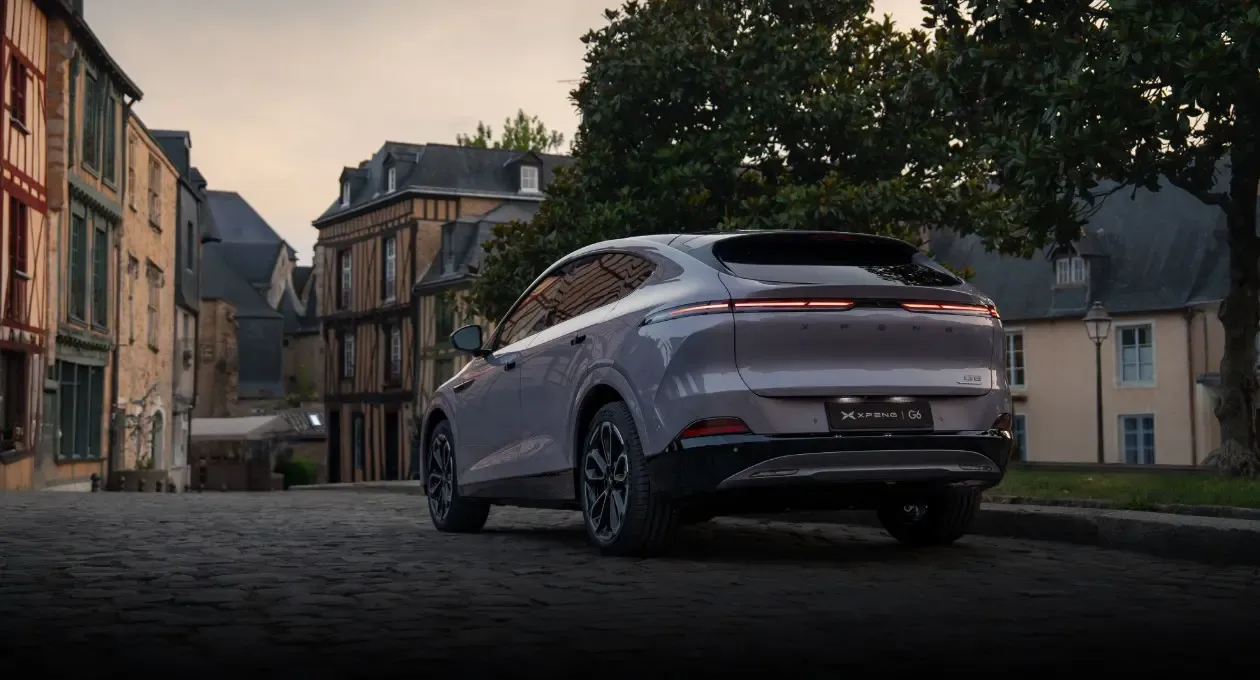
The exterior update is measured: a full-width front light bar, revised bumpers, a mild rear spoiler that completes the fastback silhouette. The "bold robot face" front design is more resolved on the facelift than the pre-facelift — the headlight graphic integrates with the new light bar rather than competing with it.
The G6's proportions — 4,758 mm long, 1,920 mm wide, 1,650 mm tall, on a 2,890 mm wheelbase — give it the stance of a premium European coupe-SUV without the European premium-SUV price tag. In Aurora Silver or the deep black metallic, the G6 looks like a car that belongs in a category above where it's priced. That's not a backhanded compliment; it's the whole point.
A Cabin That Takes the Competition Seriously
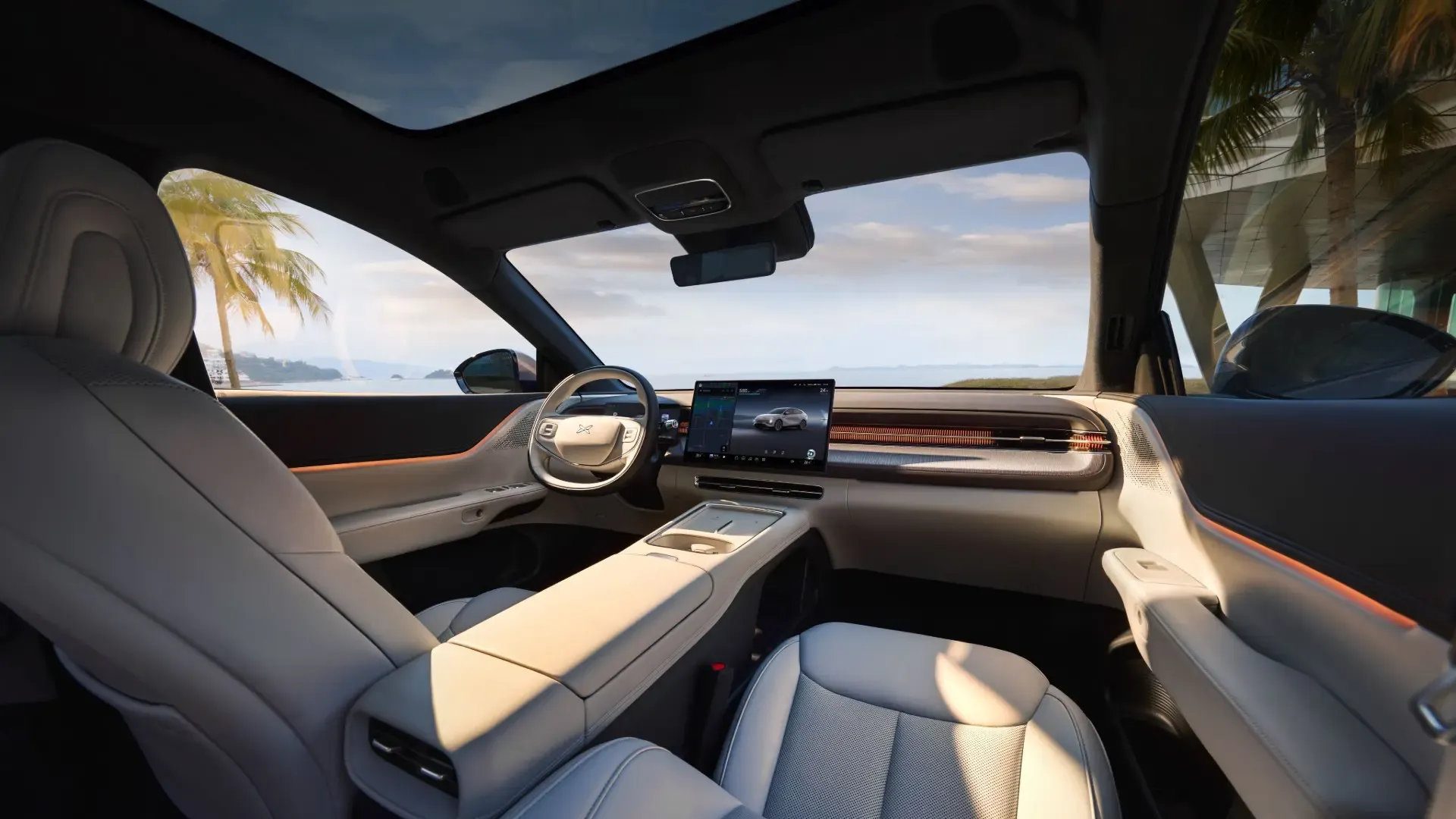
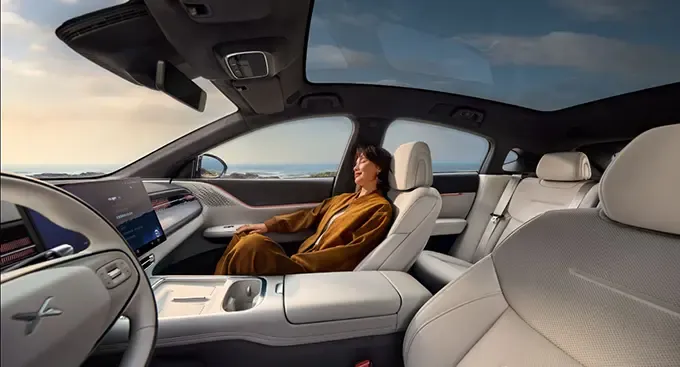
Step inside the 2025 G6 and the improvement from the original is immediate. Nappa leather seats with massage and cooling functions are standard; an Alcantara headliner adds genuine premium texture to the overhead surface in a way that most cars in this class — at any price point — don't bother with. Ambient lighting is integrated into the door cards with subtle effect. The overall impression is a cabin that has been designed to compete with European interiors rather than be forgiven for not being one.
The instrument layout has been revised for the facelift. The new standalone 10.25-inch driver instrument display gives the driver their own dedicated information surface; the 15.6-inch central infotainment screen, powered by a Qualcomm Snapdragon 8295 chip, is responsive — one of the more capable in-car computing platforms available in Singapore right now. Xpeng's software development cadence means the car receives meaningful OTA updates; the car I drove in late 2025 was materially better in software terms than early production units I had experienced.
Boot space is 571 litres, expanding to 1,374 litres with the rear seats down. Rear legroom is impressive given the coupe-SUV roofline — Xpeng has managed the slope-down without compromising rear headroom in the way some European coupe-SUV rivals do. Three adults fit across the rear seat without the middle occupant becoming a discussion point.
The G6 also features full-vehicle voice activation — the system handles commands for climate, navigation, windows, and media with reasonable accuracy without the need to confirm inputs through the touchscreen. In Singapore's traffic-heavy daily driving context, this reduces touchscreen interaction at awkward moments.
451 kW Charging: Beyond What Singapore Can Currently Use
The G6's charging architecture is, on paper, the most forward-looking in its class. The 800V platform supports up to 451 kW DC peak charging — a figure that exceeds any currently available public charger in Singapore, where the practical ceiling is around 150–200 kW at the highest-powered stations.
In practice, the G6 charges at the maximum rate the station can deliver. A 10–80% charge on the 80.8 kWh Long Range RWD at a 150 kW station takes approximately 35 minutes — competitive without being class-leading at current Singapore infrastructure. The real value of the 800V, 451 kW architecture is future-proofing: as Singapore's DC charging network upgrades beyond 150 kW, the G6 is already positioned to benefit. This is a meaningful consideration for buyers holding through a full COE cycle.
AC charging at 11 kW handles overnight top-up efficiently. For home-charging owners — which describes most Singapore buyers — the DC charging speed is relevant for weekend top-ups rather than daily use.
V2L (Vehicle-to-Load) is available on the Performance variant, supporting external power delivery up to 3.3 kW.
XPILOT and the Software Story
XPILOT — Xpeng's driver assistance suite — is the most capable ADAS system available in the segment outside of Tesla's Autopilot. The adaptive cruise control with lane centring works well in Singapore traffic, the automatic lane change works with appropriate confidence at expressway speeds, and the voice command integration means common adjustments happen without a button press.
The system's edge over comparable Korean and European ADAS in the same price bracket is in the software intelligence — it makes fewer intrusive corrections and handles ambiguous traffic situations with more composure. It is not at Tesla Autopilot's level of polish, but it is closer than most buyers would expect, and the OTA update pace means the gap narrows with time.
The remote self-parking capability — truly useful in Singapore's tight carpark culture — works reliably via the Xpeng app. The car can execute a parallel or perpendicular park, or exit a space, while you stand outside it. This sounds like a party trick; in practice, it gets used for HDB carpark spaces that don't leave enough room to open the door properly. Worth having.
On the Road: The Quiet Achiever
The G6's ride quality is where it surprises most, and where the 2025 facelift's improved tuning pays dividends. The suspension has been recalibrated for the facelift, and the result is a car that handles Singapore's varied road surfaces — smooth expressways, rougher secondary roads, the occasional poorly maintained stretch — with a composure that reads as sophisticated rather than merely acceptable.
The Long Range RWD (218 kW, 440 Nm) produces performance that is entirely adequate for Singapore's road conditions and satisfying in everyday situations. The 6.7-second 0–100 km/h figure translates to a car that is confident and reassuring at every speed, without the edginess that can accompany more powerful single-motor setups. In Normal mode, the throttle response is linear; in Sport mode, it sharpens considerably.
The Performance AWD (358 kW, 660 Nm, 4.1s to 100) is the headline. 4.1 seconds in a 1,900+ kg SUV is not a small achievement at this price point, and the AWD traction means the launch is clean rather than wheelspin-theatrical. The Performance also benefits from improved handling stability in wet conditions — Singapore's afternoon downpours are a regular feature of ownership, and AWD traction is a meaningful real-world advantage.
Noise suppression is among the best in the segment. The G6 is quieter than most reviewers expect from a Chinese EV brand, and quieter than several European rivals at similar price points.
Long Range or Performance — a Genuine Choice
G6 Long Range RWD
G6 Long Range RWD (218 kW, 80.8 kWh, Cat B):
- WLTP range: 525 km; real-world Singapore: ~480–510 km
- DC charging: up to 451 kW capable (~35 min 10–80% at 150 kW station)
- 0–100 km/h: 6.7 seconds
The Long Range RWD is the complete package for most buyers — exceptional real-world range, 218 kW of confident daily performance, and the full suite of features at a price that the European competition cannot match on value. For daily Singapore use, the 480–510 km real-world range means charging at home and largely forgetting about it.
G6 Performance AWD
G6 Performance AWD (358 kW, 80.8 kWh, Cat B):
- WLTP range: 510 km; real-world Singapore: ~460–490 km
- 0–100 km/h: 4.1 seconds
The Performance adds 4.1-second 0–100 acceleration, dual-motor AWD traction, and heated rear seats. The performance is visceral in a way that mere specification tables can't convey — and the AWD's all-conditions confidence is a meaningful differentiator in Singapore's climate.
G6 Air
G6 Air (110 kW, 66 kWh, Cat A):
- The most accessible entry point into the G6 range, strategically detuned to qualify under Cat A COE
- A meaningful option for buyers whose budget is structured around the lower COE category
The Long Range RWD and Performance AWD are both Cat B COE vehicles — the COE cost is a real consideration over the full ownership cycle. The G6 Air is the Cat A option for buyers working within that bracket.
The obvious comparison is the BYD Sealion 7 — more practical for family use, similarly priced, and a car I rate just as highly. The G6 is the better driver's car; the Sealion 7 makes more sense as a family SUV.
Why It Stays on My Shortlist
The G6 is the car that earns its position without making a single loud claim. It doesn't have the brand recognition of Tesla or the marketing push of BYD's current campaign. What it has is execution: an interior that delivers on its premium positioning, a chassis tuned for composure rather than compliance, software that is among the most capable in the category, and charging architecture that will matter more in three years than it does today.
The BYD Sealion 7 is my recommendation for most families. The Xpeng G6 is the car I'd actually own — not because it's objectively better in every metric, but because the combination of the interior quality, the XPILOT software, the quiet performance character, and the 451 kW charging architecture adds up to something that is difficult to step out of without wanting to get back in. That feeling isn't universal, but it is consistent among the people I know who have driven it seriously.
For the buyer who wants a family SUV that overdelivers on refinement, undercharges on price, and future-proofs on infrastructure — the G6 Long Range RWD deserves time on the shortlist it doesn't always get. And if the budget runs to the Performance AWD, don't let anyone talk you out of it.
Related Articles

Kia EV6 (2025): All the Right Angles
The facelifted Kia EV6 pairs sharper styling with an 84 kWh battery and 800V charging — and remains the most visually striking crossover EV at its price point. It's also the one you'll most enjoy driving. Whether that's enough depends on what you're willing to trade for it.

Hyundai Ioniq 6 (2025) Review: Aerodynamics With a Point to Prove
The Hyundai Ioniq 6 is among the most efficient EV sedans you can buy in Singapore — 800V charging, a 0.21 Cd drag coefficient, and four variants starting from Cat A. With the Tesla Model 3 as the obvious benchmark, the Ioniq 6 makes its case on efficiency and refinement rather than outright speed.

BYD Dolphin (2025): The Cat A Entry Point That Doesn’t Feel Like a Compromise
The BYD Dolphin is the most affordable EV in Singapore that still feels like a complete car. It makes the compromises you'd expect at this price point intelligently — delivering enough range, space, and technology for buyers who don't need to spend more.
Stay Charged Up
Get the latest EV news, reviews, and analysis delivered to your inbox every week.