Volvo EX30 Review Singapore: Premium Cat A EV, Asterisk Attached
The Volvo EX30 is Singapore's only premium European EV at Cat A pricing — with a ride quality that punches well above its compact footprint. But a battery recall affecting Ultra variants and persistent software frustrations complicate a car that should have been a straightforward recommendation.
Kiat Goh

Volvo has spent decades building a reputation on one word: safety. It is the core of the brand's identity — the thing that makes a Volvo a Volvo even when everything else about the car changes. So when Volvo issued a global recall in February 2026 affecting over 40,000 EX30s for a battery defect that could cause overheating during fast charging, the damage was not just logistical. It was reputational. The car that was supposed to bring premium European EV motoring to Cat A buyers in Singapore arrived with an asterisk that no amount of Scandinavian design language can erase.
The underlying car, though — the one you actually drive — is more compelling than that opening paragraph suggests. The EX30 rides better than it has any right to at this size, charges quickly, and wraps itself in materials that feel considered rather than cost-cut. The question is whether you can separate the car from the context.
The Volvo EX30 Recall: What Singapore Owners Need to Know
Let's deal with this upfront, because if you're considering an EX30, you'll hear about it.
In February 2026, Volvo recalled over 40,000 EX30s globally for a battery manufacturing defect in the 69 kWh NMC battery pack. The issue — lithium plating caused by a deficient manufacturing process — creates a risk of internal short circuits, particularly during DC fast charging above 70% state of charge. A handful of fires have been reported worldwide at a rate of approximately 0.02%. No fires, injuries, or crashes have been reported in Singapore.
In Singapore, Wearnes Automotive confirmed 194 affected units — 136 EX30 Ultra and 58 EX30 Single Motor Extended Range models, all built between September 2024 and October 2025. Affected owners have been notified. The fix is a free battery module replacement. In the interim, Volvo advises parking outdoors and limiting charging to 70%.
Here is the important distinction: the EX30 Plus, which uses a 51 kWh LFP battery, is not affected by this recall. LFP chemistry is inherently more stable than NMC — it is the same chemistry BYD uses across most of its lineup. If the recall is the thing keeping you from an EX30, the Plus variant sidesteps that concern entirely.
Design and Exterior: Small Car, Big Presence
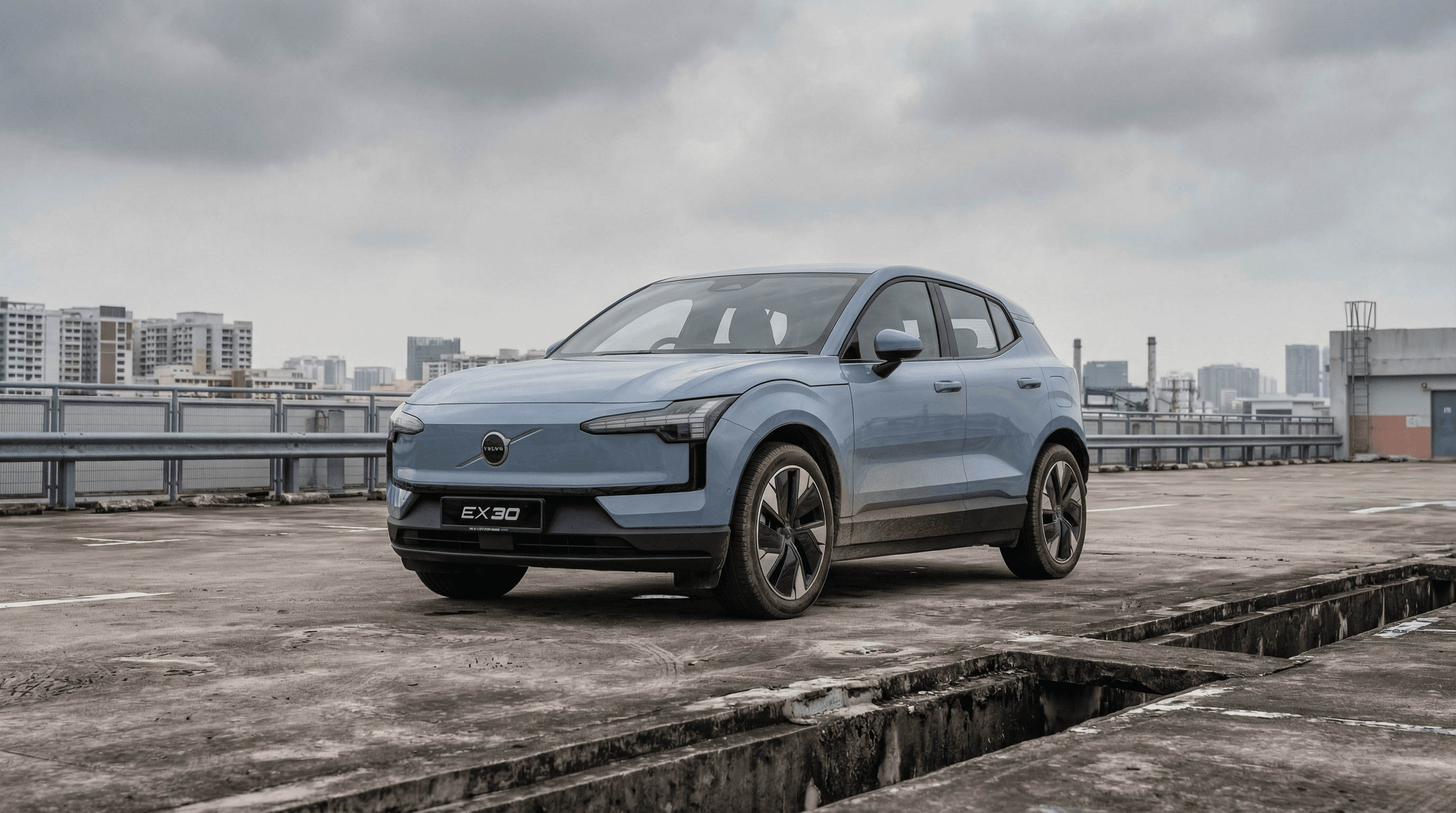
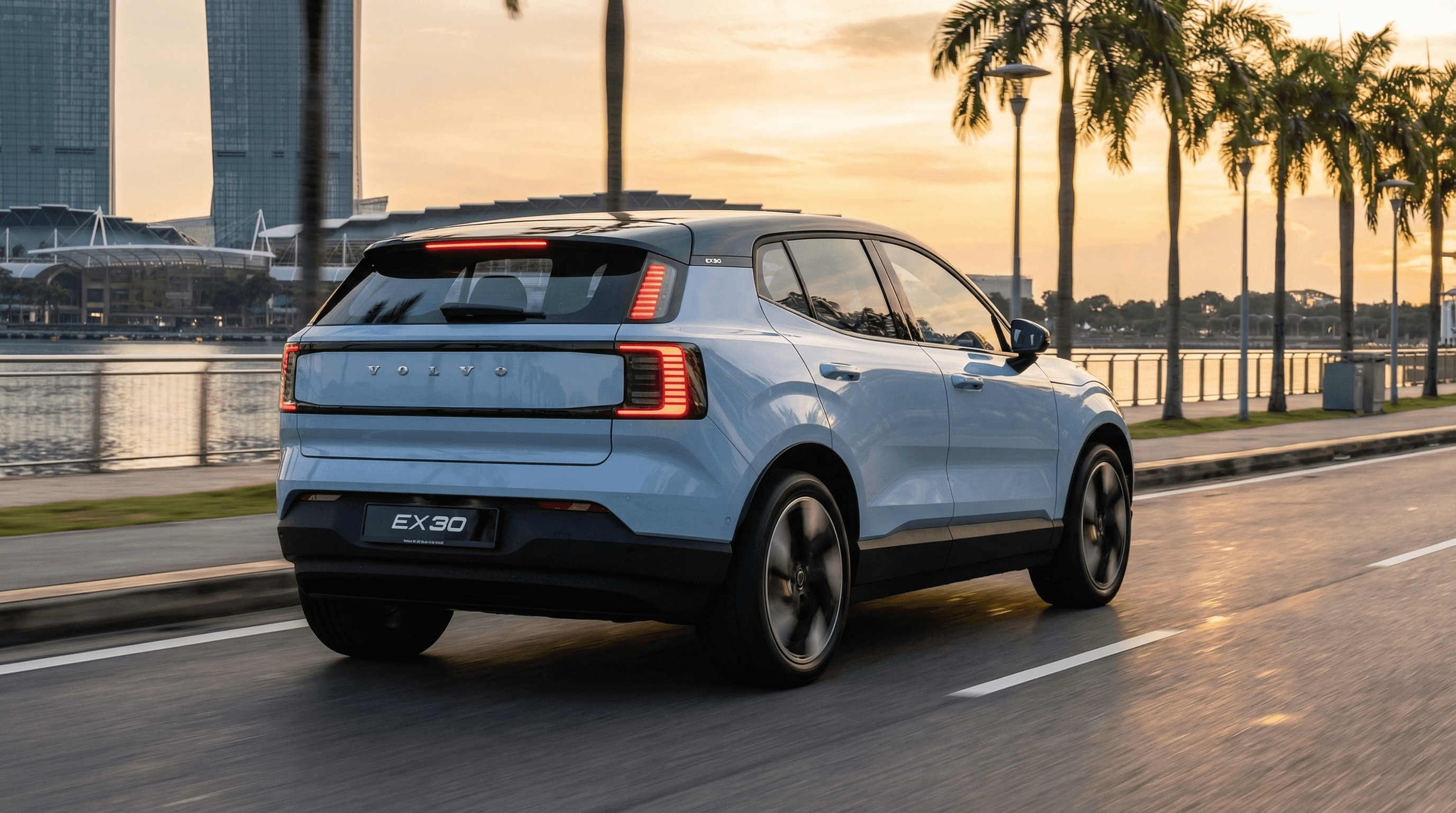
At 4,233 mm, the EX30 is shorter than a Volkswagen Golf. In a market dominated by crossovers and mid-size SUVs, that compactness is either liberating or disqualifying, depending on your needs. For what it is — a premium urban runabout — the proportions work. The roofline drops aggressively toward the rear, the shoulders are muscular for the car's size, and the face carries Volvo's Thor's Hammer LED signature without the visual weight of the larger XC and EX models.
Cloud Blue appears to be Singapore's favourite colour for the EX30, and having seen several on the road, I understand why. It is a colour that flatters the car's compact surfacing in a way that darker finishes don't — the curves catch light more visibly. The design polarises less in the metal than in photographs. It reads as purposeful rather than cute, which is a difficult balance at this footprint.
How the Volvo EX30 Drives in Singapore
This is where the EX30 earns its keep.
The ride quality — across both the 110 kW Cat A and the 200 kW variant — is the best surprise of this car. It absorbs broken surfaces with a composure that has no business being in a vehicle this size and at this wheelbase. Expansion joints, those raised metal strips at carpark entries, the uneven patching on older roads — the EX30 polishes these off with a cushioned, settled quality that reminded me of what the BYD Sealion 7 does in a much larger package. Not the same level of isolation, but the same philosophy: absorb, don't transmit.
All Singapore variants are rear-wheel drive with 343 Nm of torque. The 110 kW Cat A models reach 100 km/h in 8.6 seconds — adequate for the way Singapore actually works, where the expressway merge is the most demanding thing you'll ask of the car on a daily basis. The 200 kW variant does it in 5.3 seconds, which is brisk enough to be entertaining but not the reason to spend the Cat B premium.
The steering is light. Even at its heaviest setting, it is disconcertingly so — not enough weight to give you a confident sense of what the front tyres are doing at speed. On the expressway, this manifests as a slight vagueness around the straight-ahead that required small corrections. It settles with familiarity, but the first drive felt less assured than the steering in, say, the Xpeng G6, which gets the weighting closer to right.
Regenerative braking blends smoothly into the friction brakes — Volvo has tuned this well. What the EX30 lacks is adjustable regen strength. There is no one-pedal driving option, no toggle between light and strong recuperation. It is understood to be software-addressable, though Volvo has not confirmed a timeline. In heavy traffic, I found the fixed regen level comfortable enough. On a clear stretch where you want the car to coast, it felt slightly too interventionist.
Volvo EX30 Interior: When Minimalism Meets Compromise
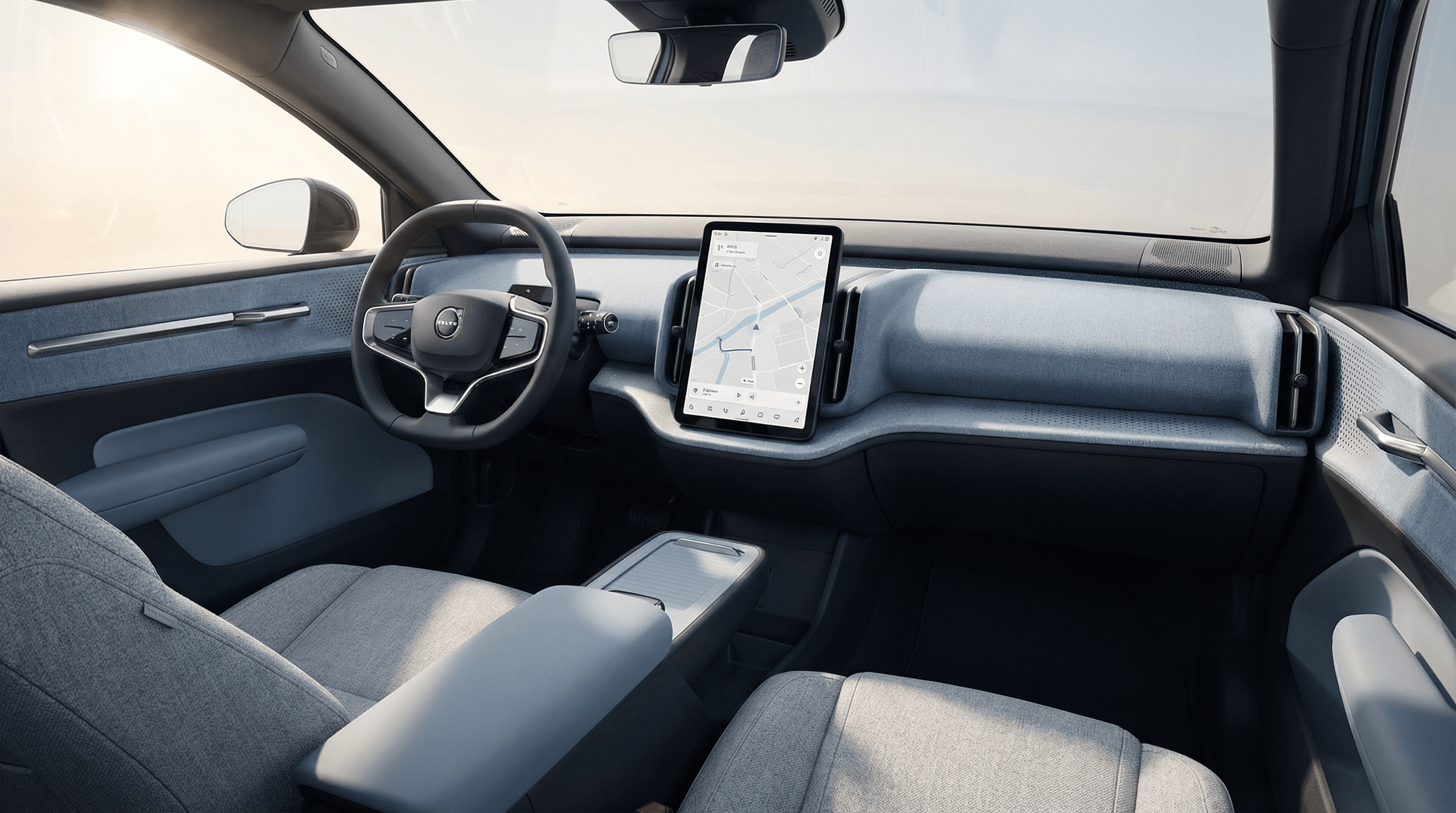
The EX30's cabin is where Volvo's design conviction is most evident — and most debated. The centre console uses recycled denim and wool-blend upholstery. The dashboard is dominated by a single 12.3-inch portrait screen. There is no instrument cluster behind the steering wheel, no head-up display, no secondary readout. Your speed, your range, your navigation — everything lives on that centre screen.
This is a design choice, not a cost-cutting measure, and Volvo commits to it fully. In practice, it takes adjustment. Glancing left for your speed rather than straight ahead feels unnatural for the first few days, and in bright afternoon light, the screen can wash out enough to make the speedometer harder to read at a quick glance. It is neither seamless nor dangerous — it just requires a recalibration of where your eyes go. Worth spending time with on a test drive to see whether it settles for you.
The front seats are excellent — supportive, well-bolstered, comfortable on longer runs. The Harman Kardon soundbar that spans the dashboard width is an unexpected highlight: the audio quality it produces from that compact form factor is a genuine step above what most cars in this class deliver.
Rear legroom is where the EX30 asks for tolerance. The high floor — a consequence of the battery pack sitting beneath — pushes your knees up, and with front seats set for anyone above 175 cm, the space behind feels tight. Thigh support is compromised by the angle. This is a consistent observation, and it is the primary reason the EX30 suits couples or small families with young children far better than it suits families needing proper rear-seat space. The BYD Atto 3, which competes directly in Cat A, is considerably more accommodating in the back — that's the trade-off for choosing the European badge.
Boot space is 318 litres with seats up, 904 litres folded — adequate for weekly shops and carry-on luggage, less so for anything involving strollers and weekend bags simultaneously. The frunk adds 7 litres, which is enough for a charging cable and not much else.
Volvo EX30 Software and Infotainment
The software is the EX30's weakest point, and it is not close.
Apple CarPlay connections dropped intermittently during my time with the car — sometimes mid-navigation, sometimes after a phone lock-unlock cycle. Bluetooth audio exhibited occasional dropouts, particularly after the car had been locked and reopened. The Volvo app was persistently slow to update vehicle status, showing stale data — the battery percentage it displayed was often a drive or two behind reality. These are not edge-case complaints. They are the texture of daily ownership.
The safety assistance systems — lane-keeping, speed-limit warnings, driver-alert monitoring — are well-intentioned but calibrated too aggressively. The speed-limit warnings are persistent enough to become background noise, which is the opposite of their intended effect. The digital key had moments where it simply refused to recognise the phone through the door handle. On one particularly humid morning, it took several attempts — something worth knowing in Singapore's climate.
Volvo has announced a significant infotainment overhaul for MY2026, including a redesigned UX with customisable content bars and V2L capability via OTA. If Volvo delivers on that timeline, the software frustrations could look very different by late 2026. That is a forward-looking statement, not a current reality.
Volvo EX30 Range and Charging in Singapore
The EX30 Plus (LFP, 51 kWh) carries a WLTP range of 337 km. The Ultra (NMC, 69 kWh) is rated at 475 km. In Singapore's tropical climate, without the range penalty that cold weather imposes, real-world figures track closer to the rated numbers than in most markets. Local reviewers returned around 300 km from the Plus in mixed driving, while the 110 kW Ultra Cat A variant managed approximately 370 km with a quarter of its battery remaining — both more than sufficient for Singapore, where the island is roughly 50 km across at its widest.
DC fast charging peaks at 153 kW on the Ultra and 134 kW on the Plus, getting you from 10–80% in roughly 26–30 minutes at a compatible DC charger. The CCS2 port means no adapter headaches with Singapore's charging networks. AC charging at 11 kW handles overnight home charging comfortably. For a fuller picture of where to charge, the revolt.sg charger map covers the current Singapore network.
For affected Ultra owners still under the recall advisory, the 70% charging cap reduces usable range — something to factor into ownership until the battery module replacement is completed.
The Verdict: Should You Buy the Volvo EX30 in Singapore?
The Volvo EX30 is a car at war with its own narrative. The hardware — the ride, the build quality, the materials, the packaging of a premium European EV into a compact Cat A footprint — makes a strong case. The software undermines it daily. The recall undermines it further, not because the statistical risk is high, but because it erodes the one brand attribute that justified paying a premium over Chinese alternatives that offer more space, more features, and fewer question marks.
If the recall does not concern you — or if you simply want to avoid the issue — the Plus variant with its LFP battery is the clearest recommendation. Cat A eligible, unaffected by the recall, with 337 km of range that covers Singapore's daily demands without anxiety. The interior is the same, the ride quality is the same, the software frustrations are the same. You lose range and gain peace of mind.
The Ultra remains the better car on paper — more range, faster charging — but asking buyers to trust an NMC pack that was recalled five months ago requires Volvo to demonstrate, not just assert, that the fix holds. If you're considering a pre-owned Ultra, a battery health check is worth the due diligence before committing.
Against the broader Cat A field, the EX30 occupies a unique position. The BYD Atto 3 offers more space and fewer ownership anxieties for less money. The Tesla Model Y Cat A variant gives you a Supercharger network and a more developed software ecosystem, though at a higher price and with a UX philosophy that trades physical controls for screens even more aggressively than the Volvo does. What the EX30 offers that neither can match is European build character in a Cat A package — the way the door closes, the way the materials feel under your hands, the way the suspension absorbs a rough patch of road.
If you want to buy an EX30 today rather than wait, the Plus is the one to take. If you can wait, the MY2026 software improvements could resolve the car's most persistent weakness. Either way, this is a car worth watching — the bones are too good for the story to end with the recall.
Related Articles

Kia EV6 (2025): All the Right Angles
The facelifted Kia EV6 pairs sharper styling with an 84 kWh battery and 800V charging — and remains the most visually striking crossover EV at its price point. It's also the one you'll most enjoy driving. Whether that's enough depends on what you're willing to trade for it.

Hyundai Ioniq 6 (2025) Review: Aerodynamics With a Point to Prove
The Hyundai Ioniq 6 is among the most efficient EV sedans you can buy in Singapore — 800V charging, a 0.21 Cd drag coefficient, and four variants starting from Cat A. With the Tesla Model 3 as the obvious benchmark, the Ioniq 6 makes its case on efficiency and refinement rather than outright speed.

BYD Dolphin (2025): The Cat A Entry Point That Doesn’t Feel Like a Compromise
The BYD Dolphin is the most affordable EV in Singapore that still feels like a complete car. It makes the compromises you'd expect at this price point intelligently — delivering enough range, space, and technology for buyers who don't need to spend more.
Stay Charged Up
Get the latest EV news, reviews, and analysis delivered to your inbox every week.