Hyundai Ioniq 6 (2025) Review: Aerodynamics With a Point to Prove
The Hyundai Ioniq 6 is among the most efficient EV sedans you can buy in Singapore — 800V charging, a 0.21 Cd drag coefficient, and four variants starting from Cat A. With the Tesla Model 3 as the obvious benchmark, the Ioniq 6 makes its case on efficiency and refinement rather than outright speed.
Kiat Goh

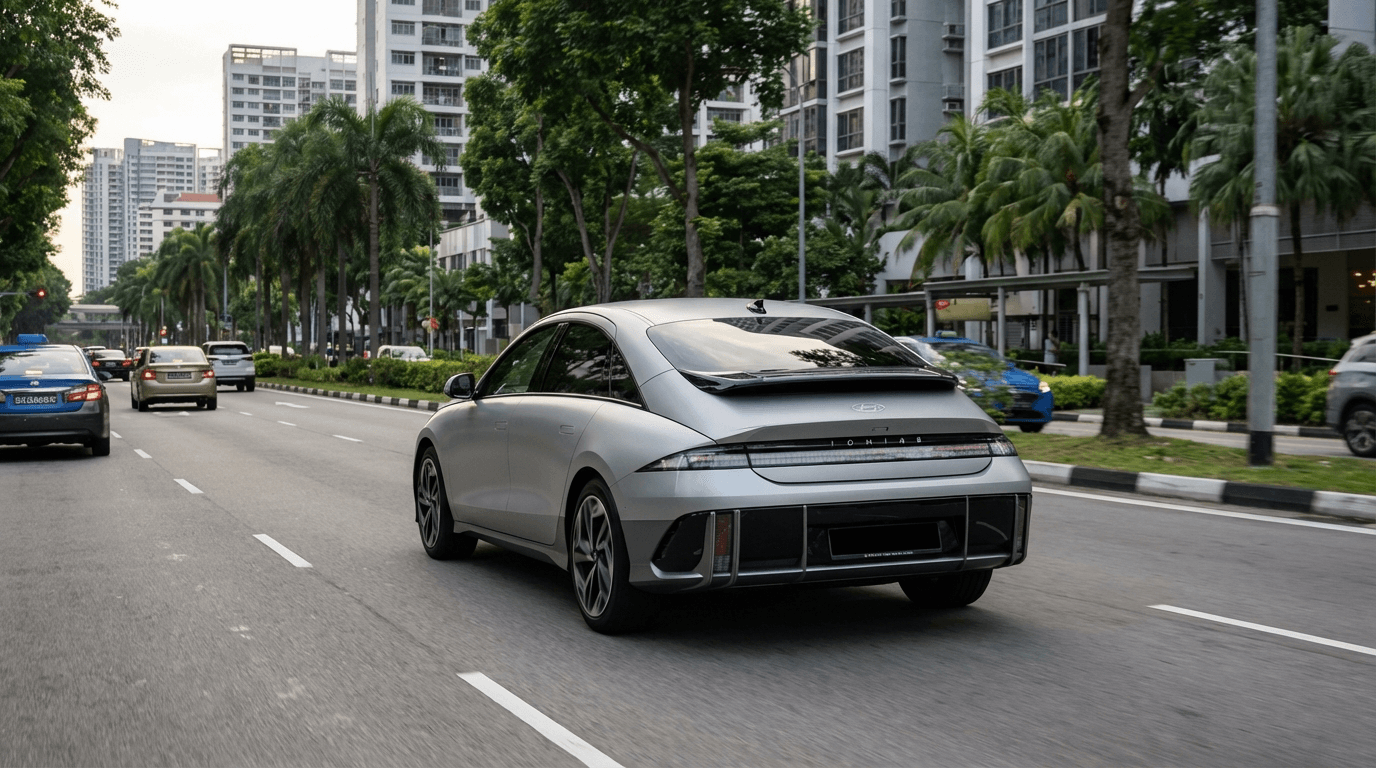
The first thing you notice about the Ioniq 6 is that nobody ignores it. Pull up at a traffic light and heads turn — not the casual glance a Model 3 gets, but the lingering double-take of a car that looks like nothing else on the road. That silhouette, dropping from a high bonnet line through a continuous arc to a truncated Kamm tail, is Hyundai's single boldest design bet since the original Ioniq 5. Whether it works for you is genuinely personal. I found myself warming to it more each day — but also wondering whether I would still feel the same way in two years.
Ioniq 6 Design: The Streamliner Up Close
The drag coefficient tells the story: as low as 0.21 Cd, which makes this one of the slipperiest production cars on the planet. Every surface serves that number. The flush door handles sit tight against the body. The rear window tapers to almost nothing. The pixel-pattern LED taillights wrap around that Kamm tail in a way that looks retro-futuristic from one angle and slightly awkward from another.
At 4,855 mm, this is a long car — longer than the Model 3 by a comfortable margin — but the roofline makes it look compact. The proportions work best in darker colours where the greenhouse blends into the body. In white, the glasshouse shape becomes more pronounced and the car reads as taller than it actually is. Those flush door handles pop out at an angle when you approach, which works fine in dry weather but can feel slippery when your hands are wet — a minor irritation that you notice more as the weeks pass.
Interior, Space, and Comfort
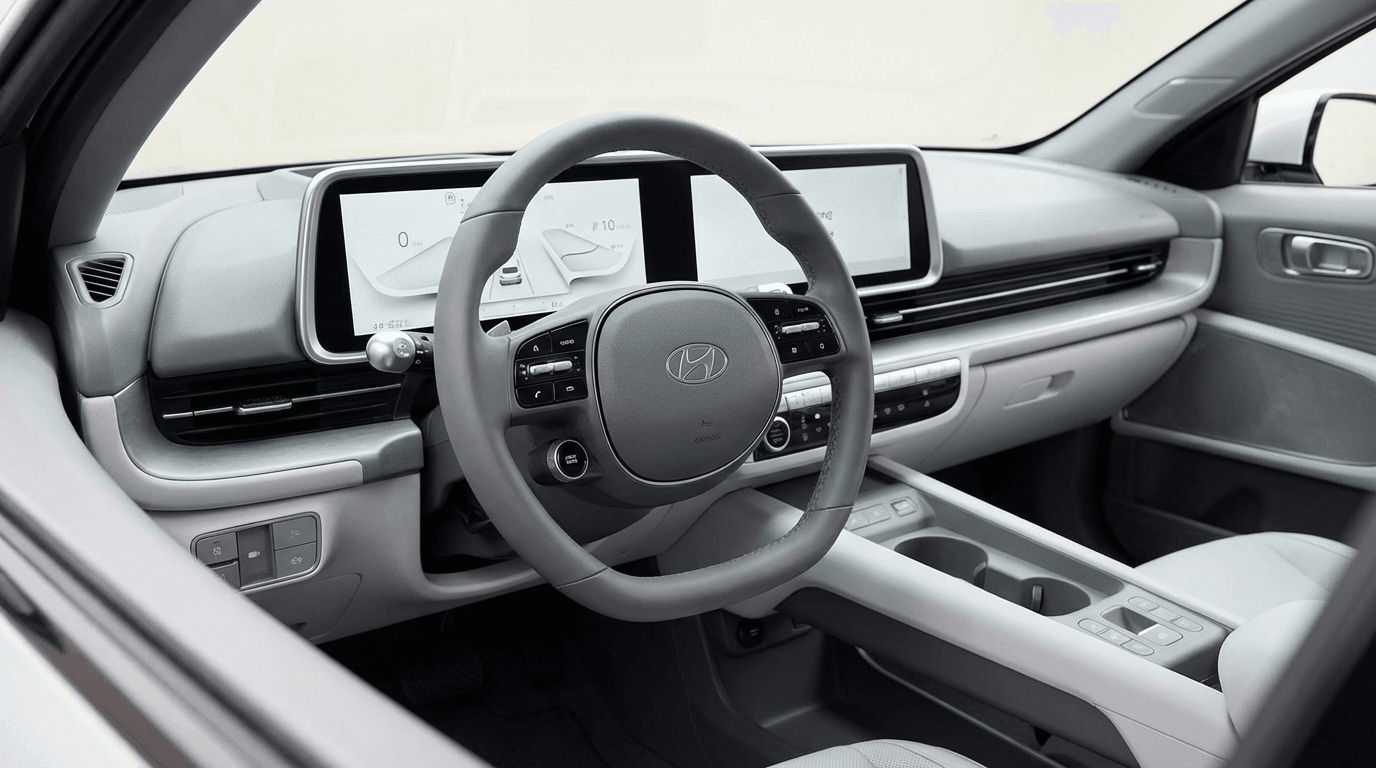
Inside, the Ioniq 6 plays a different game from its Ioniq 5 sibling. Where the Ioniq 5 goes for living-room spaciousness, the Ioniq 6 wraps you in. Twin 12.3-inch screens sit behind a slim binnacle, the ambient lighting stretches across the full width of the dash, and the materials — on the Prestige and above — feel a step above what most competitors offer at this positioning. There is a softness to the surfaces that you appreciate more when you have just stepped out of something with harder plastics.
Rear legroom benefits from the flat floor — no transmission tunnel means three adults can sit abreast without compromise. The trade-off is headroom. That dramatic roofline does what physics dictates: taller passengers will notice the ceiling closing in. It is the kind of thing that does not bother most people, but worth checking on a test drive if you regularly carry taller rear-seat passengers. The boot offers 401 litres, which is adequate, though the narrow opening makes loading bulkier items more awkward than the number suggests.
Infotainment, Tech, and Niggles
The twin-screen setup runs Hyundai's latest software with Apple CarPlay and Android Auto — wired only, which is a surprising omission when even cars positioned below this one manage wireless connectivity. It is the kind of thing that bothers you more the longer you live with the car. You reach for your phone, plug it in, route the cable somewhere sensible, and repeat the ritual every drive. Not a dealbreaker, but a friction point that feels unnecessary.
The capacitive touch controls for climate and windows are another sticking point. They look clean, they photograph well, and they are frustrating in practice — especially when you are trying to adjust the temperature without looking away from the road. Hyundai's SmartSense ADAS suite is comprehensive: lane-keeping, adaptive cruise, blind-spot monitoring. The system works well and intervenes with less fuss than some rivals, though the car can be a touch eager with its warning chimes. Paddle shifters behind the steering wheel control regenerative braking levels, and they are among the better implementations — intuitive, responsive, and they give you something tactile to interact with.
Driving Experience and Efficiency
Here is where the Ioniq 6 makes its strongest argument. The 800V E-GMP platform underpins every variant, and even the Cat A models — with 107 kW and 350 Nm — ride with a composure that belies the modest power figure. These are modest numbers on paper, and the 9.4-second 0-100 km/h time confirms it. You will not be pinning anyone to their seat. But the Ioniq 6 was never built to be fast. It was built to be efficient, and in that mission it succeeds comprehensively.
The ride is one of the best I have experienced in any EV at this level. On smooth tarmac, it glides. Over rougher patches and expansion joints, the suspension absorbs impacts without the secondary shudder that heavier EVs sometimes transmit. On a longer expressway run, the cabin stays remarkably hushed — the aerodynamic work pays dividends not just in range but in refinement. The steering is light, predictable, and not trying to pretend this is a sports sedan. It suits the car.
If you want more pace, the 77.4 kWh Prestige steps up to 168 kW with a 7.4-second sprint, while the range-topping Inspiration adds all-wheel drive with 239 kW and 605 Nm. The Inspiration addresses the performance gap, but it sits in Cat B territory — a meaningful jump for Singapore buyers.
In mixed driving — expressway cruising, urban stop-start, aircon running throughout — I saw figures around 14–15 kWh/100 km on the 53 kWh variant. The Straits Times recorded 16.6 kWh/100 km in their test, which is better than Hyundai's own claim of 16.9 kWh/100 km. However you drive it, this is an exceptionally efficient car. That 0.21 Cd is not a marketing number — you feel it in the energy consumption every time you check the trip computer.
Ioniq 6 Range: Real-World Numbers in Singapore
The 53 kWh variant claims 429 km WLTP. In practice, the real-world figure holds close to the claim — AutoApp's test covered 350 km with 20 percent battery remaining, which extrapolates to well over 400 km. For Singapore's geography, that is more range than most drivers will use between charges. The 77.4 kWh variants push that to 614 km WLTP, which is among the longest ranges available in any EV sedan here.
Hyundai backs the battery with an 8-year, 160,000 km warranty — standard for the segment, but reassuring given that early tracked cases show minimal degradation after significant mileage.
Charging: The 800V Advantage
This is the Ioniq 6's party trick. The 800V architecture delivers up to 233 kW peak DC charging, which translates to a 10–80 percent fill in roughly 18 minutes on a 350 kW charger. Five minutes plugged in adds about 131 km of range. In a market where the Xpeng G6 is one of the few other cars offering comparable 800V charging speed, this is a genuine advantage.
The practical caveat: Singapore's DC fast-charging network is still developing. Not every charger delivers 350 kW, and availability can be inconsistent depending on where and when you charge. If you are mostly home-charging with the occasional DC top-up, the speed advantage narrows. But for condo dwellers or anyone relying on Singapore's charging infrastructure as their primary source, the Ioniq 6's charging speed matters more than almost any other spec on the sheet. Some early owners reported intermittent DC charging faults on the E-GMP platform — Hyundai has since addressed these through software updates, but worth confirming on a test unit.
Which Ioniq 6 Variant Should You Buy?
Four variants, split across two COE categories. The Exclusive 53 kWh is the entry point — well-equipped but missing the Prestige's Bose audio and heads-up display. The Prestige 53 kWh adds those features and, in my view, represents the strongest case for the car: Cat A pricing, the full 800V charging architecture, and enough range for Singapore without overbuying.
Step up to Cat B and you get the 77.4 kWh Prestige with 168 kW and 614 km of range, or the Inspiration AWD with 239 kW and a 5.1-second sprint. Both are compelling if the COE category difference does not sting, but the Cat A Prestige hits the sweet spot for most buyers.
One detail worth noting: this is a car assembled by 179 robots at Hyundai's $400 million innovation centre in Jurong — the second passenger EV to come off the HMGICS line after the Ioniq 5. Local assembly has enabled OTA updates and Bluelink connectivity features that were not available on previously imported units.
Verdict: Ioniq 6 vs Tesla Model 3 vs BYD Seal
The Ioniq 6 does not try to out-Tesla the Tesla Model 3 Highland. It takes a different approach entirely: more efficient, more distinctive-looking, more tactile in its controls, but slower and without the Supercharger network behind it. For the buyer who has already decided on a Cat A EV sedan, the Ioniq 6 wins on charging speed and interior quality. It loses on the charging ecosystem — Tesla's Supercharger network remains the most reliable and widespread in Singapore. If you are mostly home-charging with the odd DC top-up, that advantage shrinks considerably.
Against the BYD Seal, which offers more outright value and the clever cell-to-body platform, the Ioniq 6 trades on refinement and charging speed. The Seal is the more aggressive proposition; the Ioniq 6 is the more considered one.
The Prestige 53 kWh is the one I would take. It hits Cat A, charges faster than nearly anything else at this level, and the ride quality alone justifies putting it on your shortlist. The design will divide opinion — give it six months and see if you are still looking back at it in the carpark. If you are, you have found your car.
Related Articles

Kia EV6 (2025): All the Right Angles
The facelifted Kia EV6 pairs sharper styling with an 84 kWh battery and 800V charging — and remains the most visually striking crossover EV at its price point. It's also the one you'll most enjoy driving. Whether that's enough depends on what you're willing to trade for it.

BYD Dolphin (2025): The Cat A Entry Point That Doesn’t Feel Like a Compromise
The BYD Dolphin is the most affordable EV in Singapore that still feels like a complete car. It makes the compromises you'd expect at this price point intelligently — delivering enough range, space, and technology for buyers who don't need to spend more.
Stay Charged Up
Get the latest EV news, reviews, and analysis delivered to your inbox every week.