Stay Charged Up
Get the latest EV news, reviews, and analysis delivered to your inbox every week.
Get the latest EV news, reviews, and analysis delivered to your inbox every week.
The facelifted Kia EV6 pairs sharper styling with an 84 kWh battery and 800V charging — and remains the most visually striking crossover EV at its price point. It's also the one you'll most enjoy driving. Whether that's enough depends on what you're willing to trade for it.
Kiat Goh

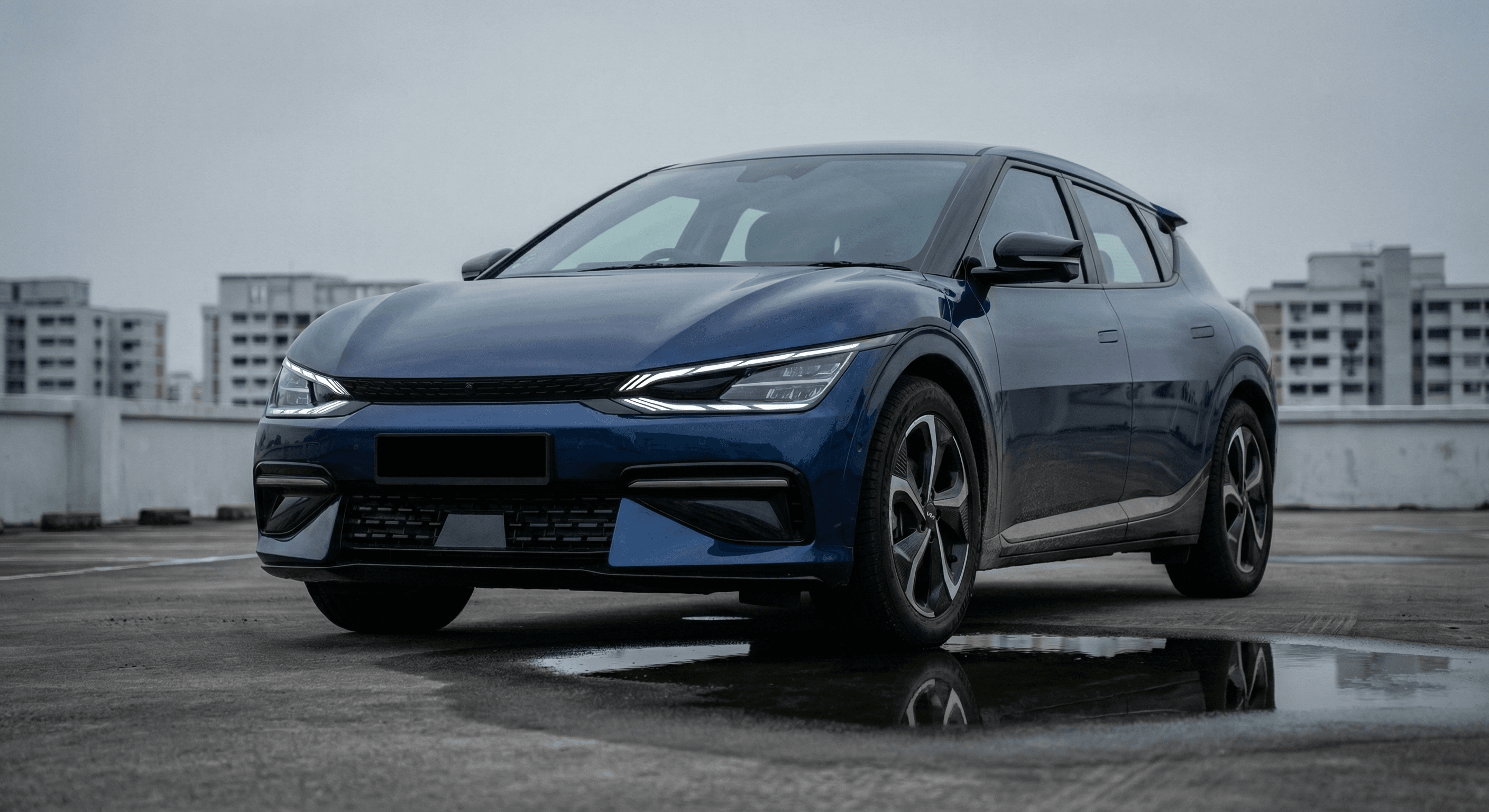
You notice the EV6 before you notice it's a Kia. That's the compliment and the challenge wrapped into one sentence. The crossover-coupe silhouette, the aggressive rear haunches, the full-width LED light bar — they belong on something considerably more expensive. It's the rare mass-market EV that earns a second glance in a carpark full of Teslas, and the facelift has only sharpened that advantage. New Star Map headlights sit lower and wider. The front fascia drops into something more angular, more deliberate. If the pre-facelift EV6 was a looker, this one knows it.
But good looks only matter if the car underneath can keep the promise. Kia has bumped the battery to 84 kWh, refined the suspension, updated the cabin with a panoramic curved display, and addressed the reliability concern that shadowed the earlier car. The question for Singapore buyers isn't whether the EV6 is desirable. It's whether desirability is enough.
The EV6's proportions are its best feature, and the facelift has the good sense to leave them alone. This is still a cab-forward crossover with a dramatically raked rear window, a long wheelbase relative to its overhangs, and a stance that sits lower and wider than the category norm. At 4,695 mm long on a 2,900 mm wheelbase, it's within centimetres of the Tesla Model Y in footprint but carries itself with far more visual tension.
The changes are at the face. Star Map LED daytime running lights — the same design language filtering across Kia's EV range — replace the previous sequential indicators with a more geometric pattern. The lower front air intake is wider and cleaner. At the rear, dynamic turn indicators sweep outward in a way that's just theatrical enough to be satisfying without being obnoxious.
Wheel choice matters. The 19-inch aerodynamic alloys fitted to the Singapore spec suit the car's proportions well — a larger rim would look better parked but ride worse on our roads. The colour palette rewards the bolder choices; lighter metallics expose the surfacing more honestly. In darker shades, the body-coloured cladding blends seamlessly and the car reads as a compact sports coupe rather than a crossover.
Inside, the facelift brings an upgrade that was overdue: the dual 12.3-inch curved panoramic display. The previous car's flat screens and physical toggle bank have been replaced by a single sweeping panel that stretches from behind the steering wheel across to the centre stack. It's a layout borrowed from the EV9, and it immediately lifts the interior perception. A 12-inch head-up display complements the main screens and projects speed, navigation, and ADAS alerts onto the windshield — useful in a way that justifies its presence rather than feeling like a spec-sheet bullet point.
The driving position is lower than you'd expect from a crossover, closer to a sedan than an SUV. The seats are supportive through corners and offer heating, ventilation, and a near-horizontal recline mode for charging stops — Kia calls them relaxation comfort seats. In practice, the recline function is a novelty you'll try once, but the ventilation is something you'll use every day in Singapore.
Material quality sits comfortably among its peers. The upper dashboard surfaces are soft-touch, the stitching is deliberate rather than decorative, and Kia's use of sustainable materials — recycled PET, vegan leather — doesn't come at the expense of tactile quality. Where the cabin doesn't quite match is ambiance: the interior colour palette skews dark and functional where rivals like the Xpeng G6 have figured out how to make a cabin feel warm without spending more on materials. The G6's interior still sets the benchmark for how inviting a crossover EV cabin can feel at this level.
Boot space is 490 litres with the seats up, expanding to 1,300 litres with them folded. That's adequate but not generous — the Model Y offers more usable cargo volume, and the Ioniq 5 swallows large items more easily thanks to its boxier shape. The frunk is essentially a place for your charging cables and nothing more. One notable absence: there's no spare tyre. Kia provides a sealant kit and roadside assistance instead — a point of frustration worth knowing about, especially if you're the kind of driver who makes regular trips across the border.
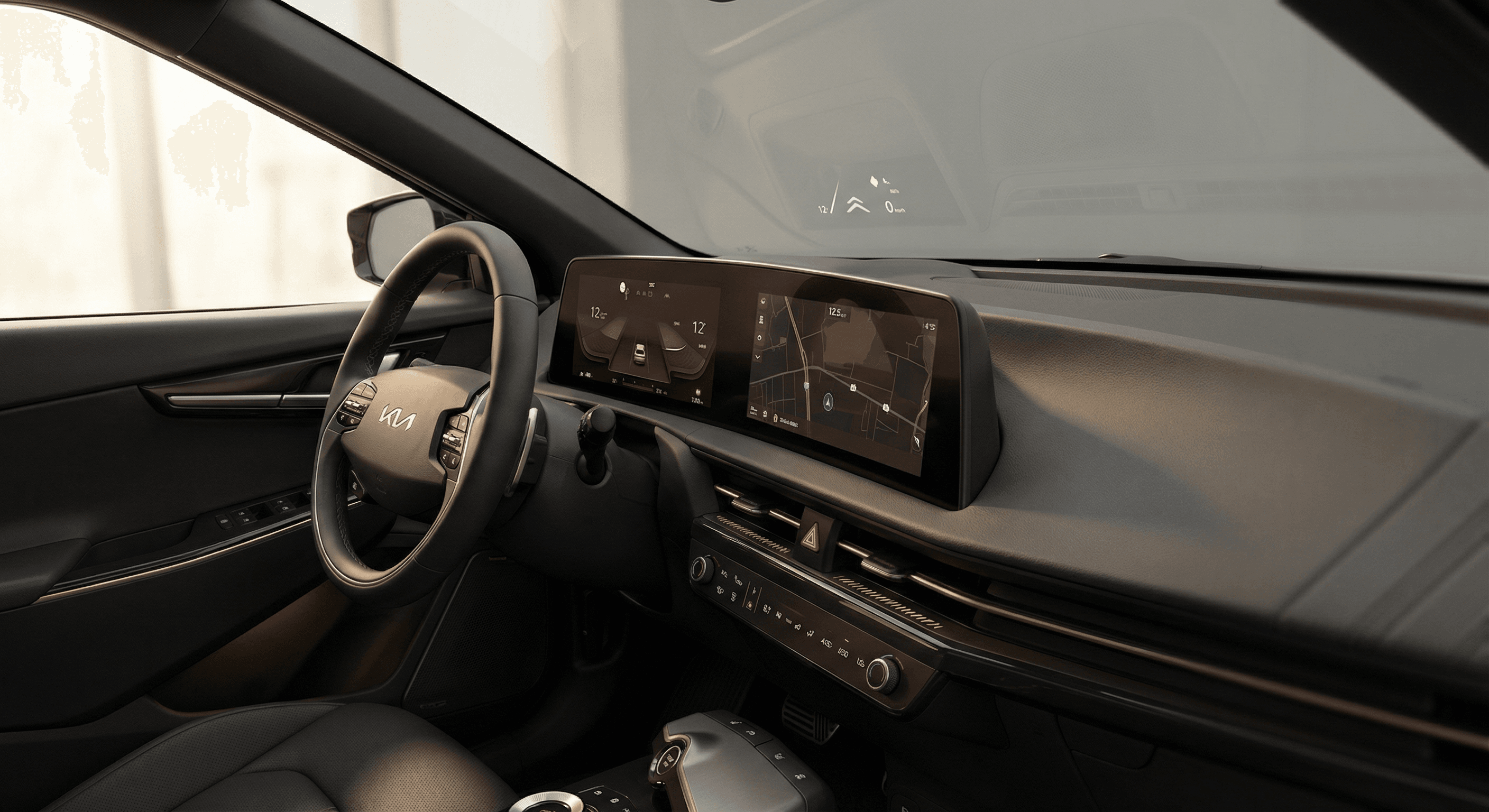
The curved display runs Kia's latest ccNC infotainment software with sharper graphics and noticeably improved responsiveness compared to the pre-facelift system. Navigation, media, and vehicle settings are logically structured, and physical climate controls survive below the screen — a decision I'll never stop appreciating. Wireless Apple CarPlay and Android Auto are now standard, correcting one of the pre-facelift car's more baffling omissions.
New to the facelift is a fingerprint authentication system that stores driver profiles, adjusting seat position, mirrors, and display preferences on recognition. It works reliably enough and saves a few seconds each time you switch drivers, though most single-car households won't use it daily.
The Meridian premium sound system is respectable out of the box, but there's a curiosity worth knowing about: earlier EV6 models shipped with the subwoofer wired in reverse polarity from the factory, causing phase cancellation that muted the bass response. The fix is a straightforward wiring swap that takes minutes. Whether the 2025 facelift addresses this from the factory is worth confirming on your test drive — turn up something bass-heavy and listen critically.
The Kia Connect app handles remote climate, charging scheduling, and vehicle status. It works, but with enough lag and occasional disconnections that it feels a generation behind Tesla's app. Scheduled charging doesn't always trigger reliably — if you charge on a fixed schedule, verify the feature works consistently on your unit before relying on it.
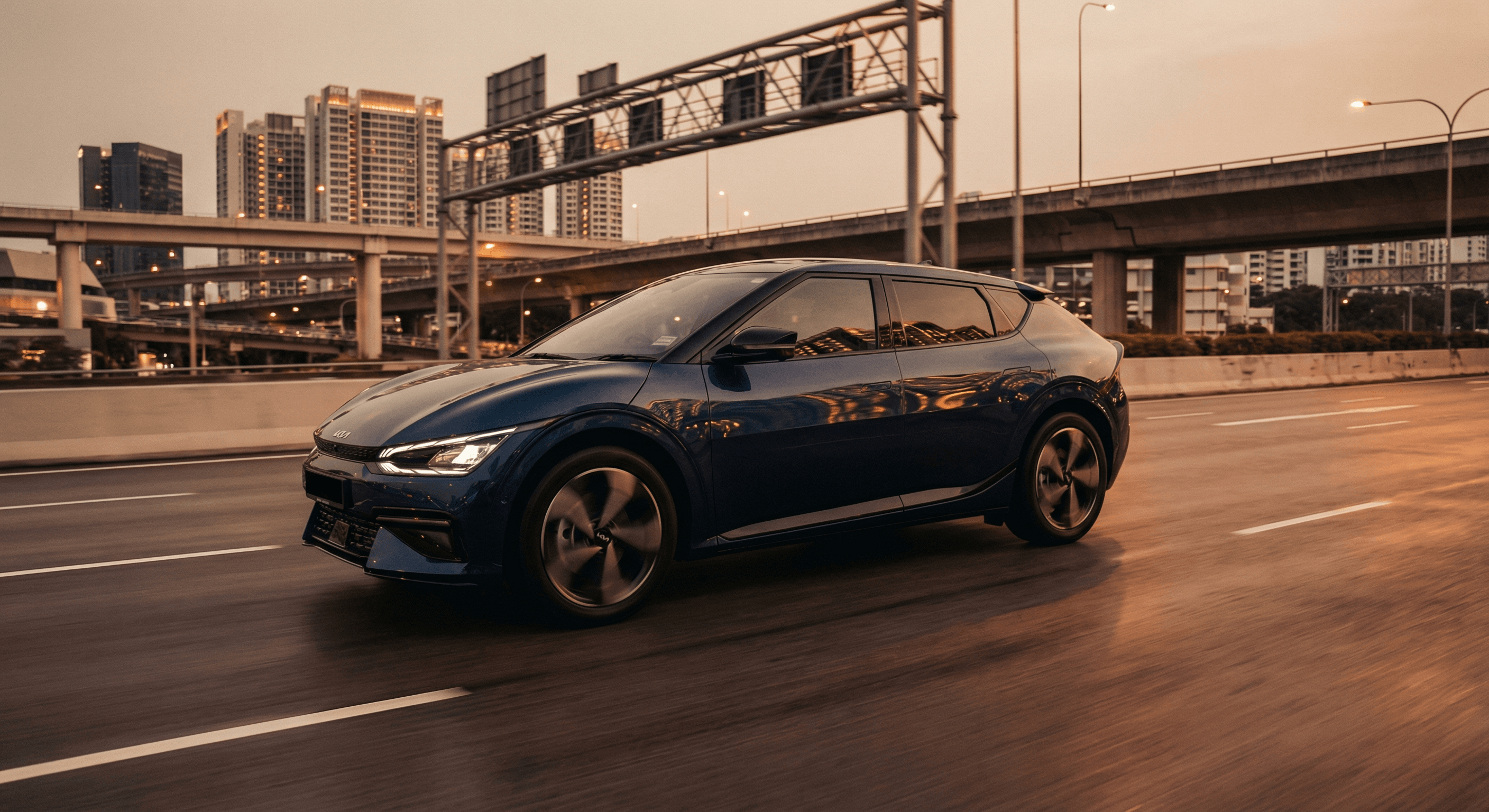
The EV6 does something unusual for a crossover at this price: it makes you want to take the longer route. The steering is direct and well-weighted, with a consistency through the mid-range that gives you confidence to carry speed through sweeping turns. It's not sports car feedback — this is still a car north of two tonnes — but there's a connection through the wheel that's absent from the Model Y and noticeably sharper than what the Ioniq 5 offers on the same E-GMP platform. The family resemblance is there in the underpinnings. The personality is entirely the EV6's own.
The single rear motor delivers 0–100 km/h in 8.7 seconds. On paper, that's modest by EV standards. In practice, the way the power arrives — linear, progressive, without the violent shove that some EVs mistake for performance — suits the car's character. There's enough urgency for expressway merges and enough restraint that passengers don't brace at every traffic light. The dual-motor AWD GT-Line isn't available here, but what Singapore gets is a car that's fast enough to be satisfying and composed enough to be comfortable — the smarter balance for daily use.
The revised suspension is where the facelift earns its keep. The pre-facelift car had a firm edge that could feel unsettled over rougher surfaces and expansion joints. This version is noticeably more composed. The damping absorbs mid-frequency impacts — the kind you encounter on every other road here — without the secondary shudder that characterised the earlier car. On a longer run at steady speed, the cabin is hushed in a way that makes the Meridian system sound better and the journey feel shorter. Extra sound-deadening material in the floor and wheel arches contributes — the improvement is immediately apparent if you've spent time in the pre-facelift model.
Regenerative braking deserves a specific mention. The four-level paddle system plus i-Pedal one-pedal driving mode gives you more control over energy recovery than most EVs offer. The calibration is well-judged — regen feels natural and predictable in heavy traffic, and the transition between regenerative and mechanical braking is smooth enough that you stop thinking about it after the first day. In i-Pedal mode, the car will brake to a complete standstill, and the learning curve from two-pedal driving to one is shorter than you'd expect.
The Singapore-spec EV6 carries an 84 kWh NMC battery — a substantial step up from the 58 kWh unit in the pre-facelift car. Kia Singapore quotes up to 644 km of WLTP range. In Singapore's real-world conditions — air conditioning running permanently, mixed urban and expressway driving — expect around 450 to 500 km, which is a serious improvement over the earlier car and puts the EV6 in competitive territory alongside the BYD Seal Premium and the Model Y Long Range.
For most Singapore commuters covering 30 to 60 km daily, that's easily a full working week between charges. The EV6's range has gone from a caveat in the previous generation to a non-issue in this one. The long wheelbase and relatively slippery crossover shape help with efficiency, though the ride height means it can't quite match the lower-slung Ioniq 6, which extracts more from the same 800V architecture by being shaped like a teardrop.
A Swedish study of used EV battery health found the EV6 showed the least degradation of all models tested — reassuring for a car registered in Singapore, where you're committing meaningful capital. If long-term battery condition matters to you — and in Singapore it should — an independent battery health check before your warranty expires is worth considering. Kia backs the battery with a 7-year, 150,000 km warranty.
This is where the EV6 sharpens its case against the field. The 800V architecture means DC fast charging completes a 10–80% top-up in approximately 18 minutes on a compatible ultra-fast charger. In practical terms: park, buy a coffee, and you're back to a usable charge before the queue moves. Singapore's expanding network of 150–360 kW DC chargers from SP Group, Shell Recharge, and others means this isn't a theoretical benefit — you can find a compatible station within reasonable distance of most daily routines.
The Xpeng G6 shares the 800V advantage — it was one of the reasons that car impressed me so much when I drove it — but the EV6 got there first in this market, and the charging experience remains among the best available. AC charging at 11 kW handles overnight top-ups in roughly eight to nine hours — comfortably within a night's sleep.
V2L is standard: 3.6 kW of power output from the car to external devices. It's the kind of feature you don't need until you do — powering a laptop at a weekend campsite, running a portable fan at an outdoor event, or keeping essential devices charged during an outage. The EV6 was one of the first mass-market EVs to offer this, and it remains a differentiator that most competitors still haven't matched at this level.
Earlier EV6 models — specifically the 2022 to 2024 production run — were affected by a well-documented issue with the Integrated Charging Control Unit, or ICCU. A faulty transistor could prevent the 12V battery from charging properly, leading to warning lights, reduced performance, and in some cases a complete loss of drive power. Kia issued recalls and software updates. In some cases, the initial fix didn't hold. It was, for a period, the EV6's most significant ownership headache.
The 2025 facelift addresses this with revised ICCU software logic from the factory. As of this review, no recalls or related complaints have been logged against the 2025 model year. One long-term owner with over 200,000 km on the clock had the ICCU replaced but still rates the car highly and reports minimal maintenance costs otherwise — the kind of real-world evidence that counts for more than a press release. Consumer Reports, which rated earlier EV6 models well below average for reliability, now scores the current car at 4.1 out of 5. The direction is clear. Whether it holds through a full ownership cycle is the remaining question — worth monitoring, not worth avoiding.
The Kia EV6 facelift does something that few EVs in Singapore manage: it makes you feel something. Not through outright speed or spec-sheet maximalism, but through design conviction and driving engagement. The 800V charging architecture is a tangible daily advantage. The 84 kWh battery puts range anxiety to rest. The revised suspension settles the ride quality question. The driving dynamics remain the sharpest of any crossover EV at this price point. And the design, three years on from the original launch, still turns heads — because the proportions are resolved in a way that most mass-market EVs simply aren't.
Where the EV6 gives ground is the ecosystem. Tesla's app integration, Supercharger network, and software update cadence remain the benchmark, and the Model Y's frictionless ownership experience is hard to replicate. The Kia Connect app lags behind. The infotainment, while improved, doesn't match the responsiveness of the best Chinese systems — the BYD Sealion 7 and the Xpeng G6 both feel a step ahead on software polish. And the ICCU history, while addressed, leaves a residue of caution that only time will fully dissolve.
Here's where I land: the EV6 is the crossover EV I'd most want to drive every day. If the way a car looks and the way it handles matter to you — if those things carry weight alongside app connectivity and ecosystem convenience — the EV6 makes its case with more conviction than anything else at this level. Given the choice between a car that stirs something every time you walk towards it and a car that never gives you a reason to think about it, I know which I'd choose. The reliability story needs another year or two of data to close completely, but seven years of battery warranty buys real confidence, and the engineering direction is clearly right.

The Hyundai Ioniq 6 is among the most efficient EV sedans you can buy in Singapore — 800V charging, a 0.21 Cd drag coefficient, and four variants starting from Cat A. With the Tesla Model 3 as the obvious benchmark, the Ioniq 6 makes its case on efficiency and refinement rather than outright speed.

The BYD Dolphin is the most affordable EV in Singapore that still feels like a complete car. It makes the compromises you'd expect at this price point intelligently — delivering enough range, space, and technology for buyers who don't need to spend more.

The Volvo EX30 is Singapore's only premium European EV at Cat A pricing — with a ride quality that punches well above its compact footprint. But a battery recall affecting Ultra variants and persistent software frustrations complicate a car that should have been a straightforward recommendation.