Tesla Model Y (2025): The Juniper Refresh Is Better Than It Needed to Be
Tesla's most important car for Singapore gets a significant update — quieter, softer, better equipped, and now available in a Cat A variant. The engineering is harder to argue with than ever. The UX philosophy remains a matter of taste.
Kiat Goh

Five years into its Singapore lifespan and the Tesla Model Y has never been the car it is today. The Juniper refresh — which landed in Singapore in early 2025 — takes what was already the country's best-selling EV and applies a level of development that answers most of the criticism levelled at the previous generation. The ride is better. The cabin is quieter. The interior is more thoughtfully appointed. The rear-seat experience has been substantially upgraded.
It's enough of a change to treat the Juniper as a distinct car rather than a running update. Whether that change resolves your reservations depends on what your reservations were.
The Juniper's New Face
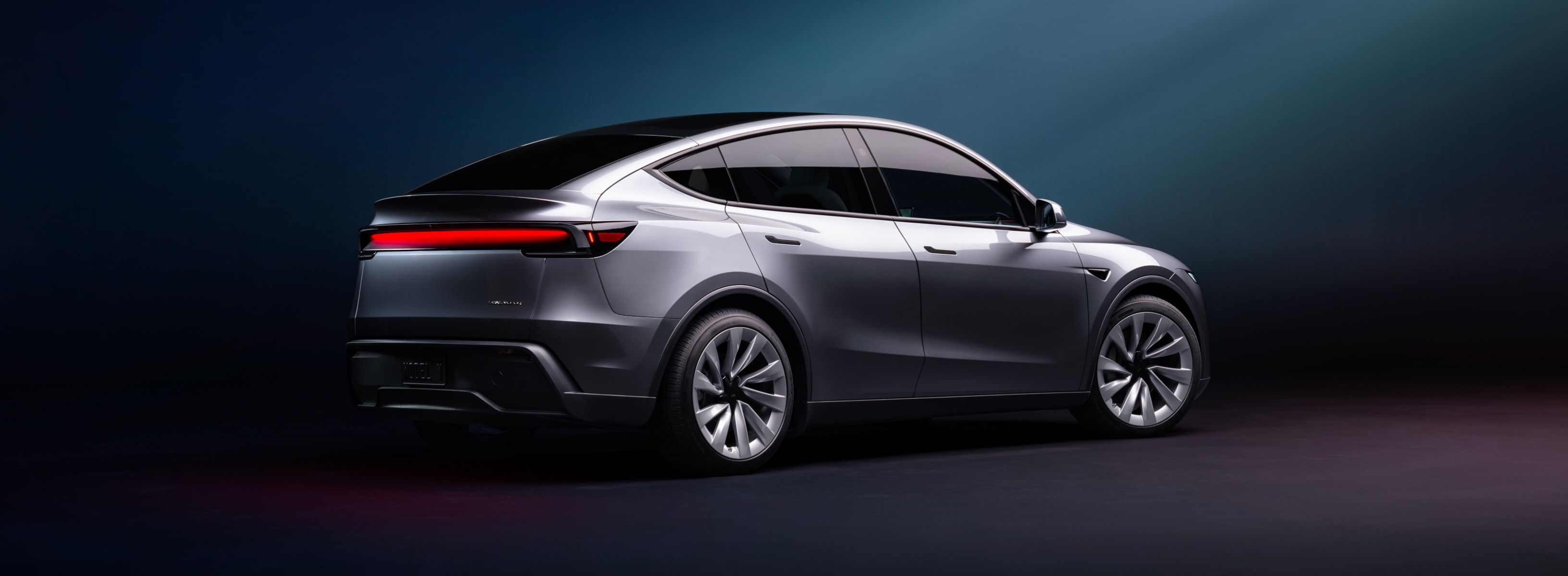
The exterior update is evolutionary rather than transformational — the Model Y's proportions remain recognisable — but the details are done well. New LED headlights with a sharper graphic; a full-width light bar at the rear with Tesla's name integrated into the illuminated panel; and a subtle aerodynamic tightening that brings the drag coefficient from 0.23 to 0.22. That last number matters: a lower Cd is part of why the Juniper's WLTP range improves on the previous generation's figure.
The result reads as a more resolved design. The pre-Juniper Model Y had a slightly anonymous quality in profile — it looked competent without looking particularly considered. The Juniper's rear is now a design feature rather than an absence of one.
Colours for Singapore are restrained: Pearl White, Midnight Cherry Red, Stealth Grey (matte-look), and Ultra Red for those who prefer a brighter finish. The matte-look Stealth Grey is worth considering — it suits the revised design well and ages without the polishing attention that pearl paint demands.
Inside: The Second Chapter
The cabin is where the Juniper earns the most ground, and where it addresses the most common criticisms of its predecessor.
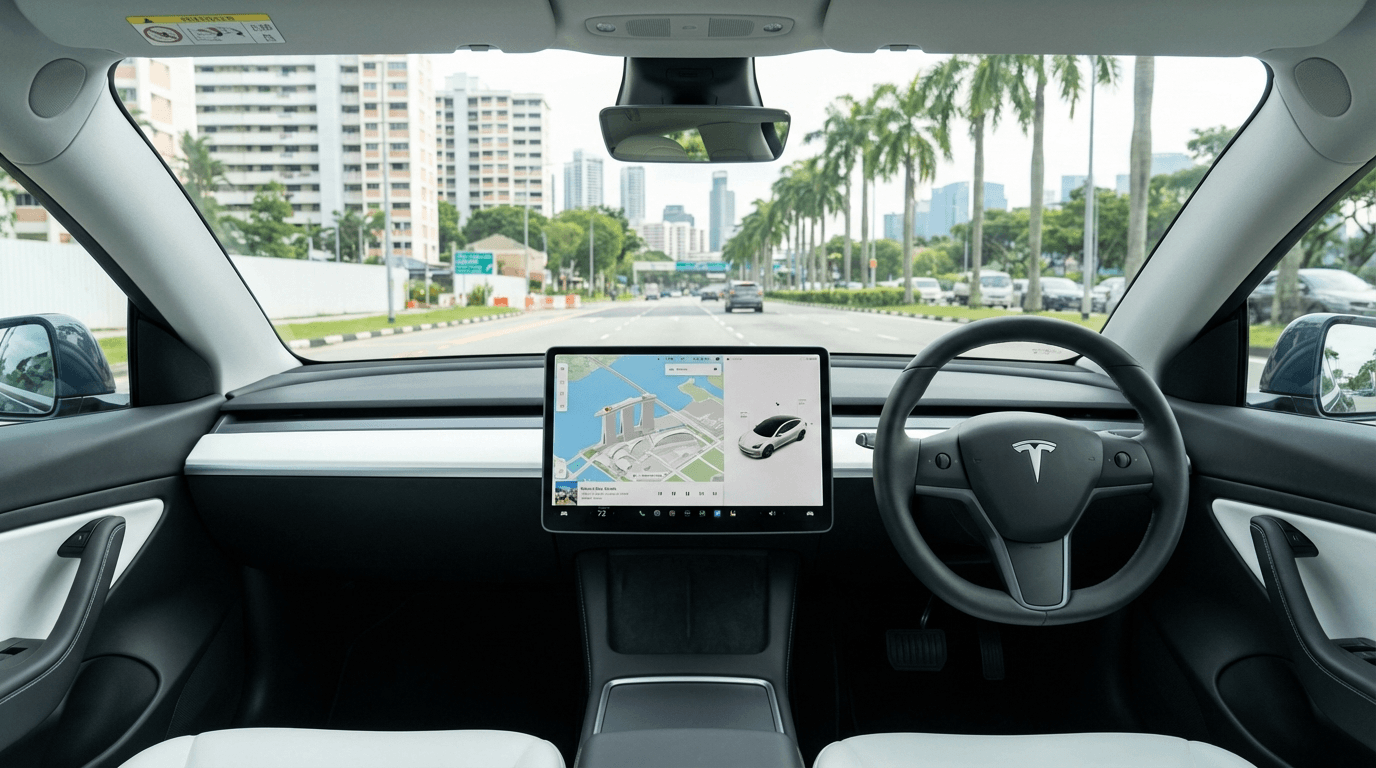
The materials are better — softer, higher-grade surfaces across the dashboard, more consistent texture quality on the door panels. The ambient lighting is new and does what it should: makes the space feel intentional after dark without being performative. Ventilated front seats are standard, and at Singapore's ambient temperatures that goes from optional luxury to immediate practical benefit.
The rear seat is genuinely transformed. New reclining capability — by around 8 degrees — changes the rear cabin from a serviceable holding area into a comfortable seat for longer journeys. An 8-inch rear passenger touchscreen controls climate and entertainment in the back; it works well and the response time is fast. Families with older children will find this addition more appreciated than the adults might initially expect.
Boot space remains 822 litres seats up and expands significantly with them folded. The frunk is retained. The Model Y continues to be one of the most practically capable compact SUVs in the category — it stores more than some larger-looking rivals, and the flat floor with the rear seats down produces a useful load area.
Build quality has tightened. Panel gaps that were a recurring complaint among Model Y owners are more consistent on the Juniper; the door shuts feel more solid and the headliner trim fits without the occasional catching that earlier builds produced.
The UX Question — Fair Warning
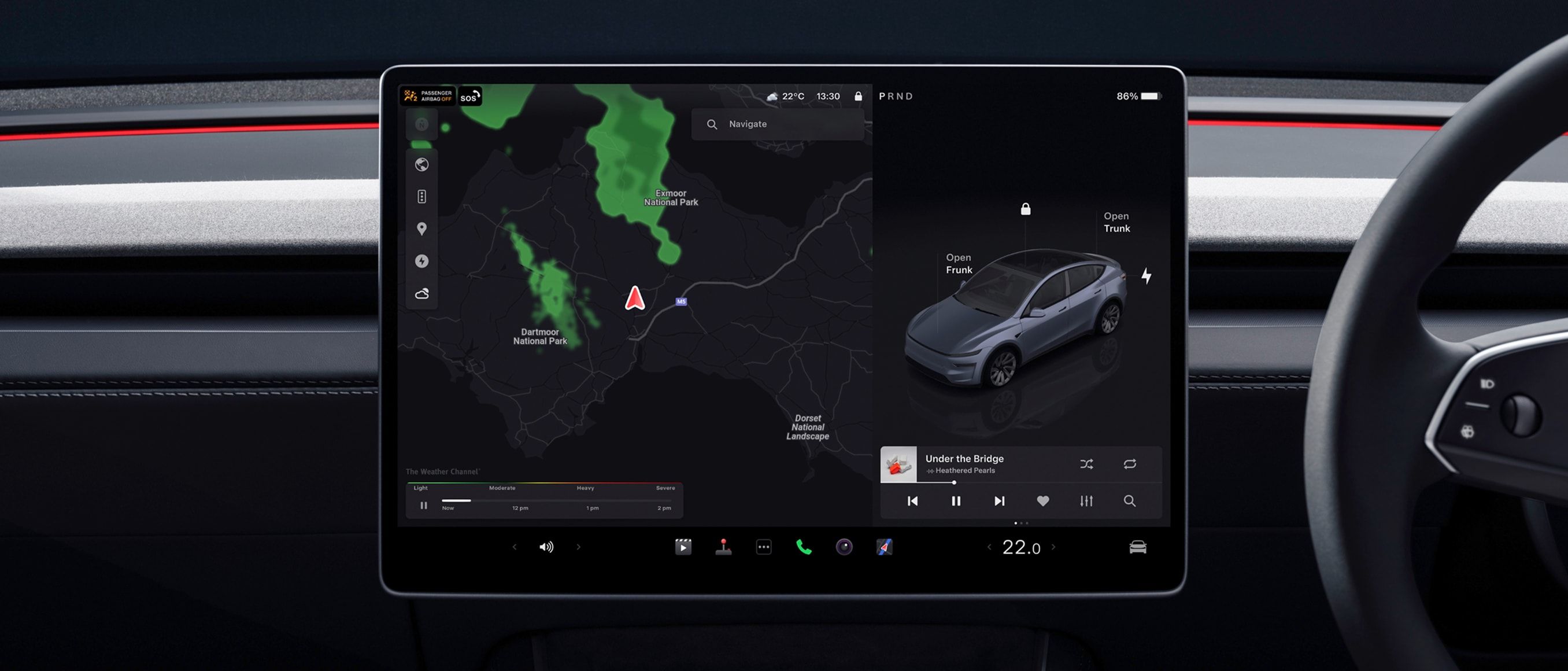
The Tesla OS experience is, in many respects, the best infotainment platform in the category. The 15.4-inch touchscreen is responsive, the menus are logical, the map is excellent, the OTA update cadence is truly industry-leading. If you're already in the Tesla ecosystem, or arriving without strong prior preferences, you'll adapt quickly.
What I find harder to accept — and worth naming plainly — is the philosophical commitment to removing physical controls from functions that benefit from them. Gear selection is now fully touchscreen-based on the Juniper; the indicator stalk has been retained (a concession that improves on some other Tesla models), but the absence of a physical gear selector is a daily moment of additional cognitive load that doesn't need to exist. It's a UX position, not an engineering constraint.
The other significant limitation is the absence of Apple CarPlay and Android Auto. Tesla's proprietary navigation and media system is good — the maps are up to date, Spotify and streaming integrations work well, and phone connectivity via Bluetooth is stable. But for buyers who have built their digital lives around CarPlay, this is a real adjustment rather than a minor one.
These are preferences, not dealbreakers. Many Tesla owners adapt within the first week. I'm noting them because they represent a genuine difference in how Tesla thinks about the car relative to how most competing manufacturers do — and that gap persists in the Juniper.
How It Drives in 2025
The Juniper's ride quality is the single most meaningful improvement over the previous generation. The suspension tune is softer and more absorbent, and the cabin insulation — improved by around 20% according to Tesla — makes a real difference at highway speeds. The pre-Juniper Model Y could be fatiguing on longer runs; the Juniper is noticeably calmer.
The RWD 110 — Tesla's Cat A-eligible variant, with the motor capped at 110 kW for COE classification — is the review unit most Singapore buyers will consider first. 350 Nm of immediate torque means the 9.6-second 0–100 km/h figure is deceptive in daily traffic: the Model Y never feels slow at the speeds Singapore driving requires. The 9.6 seconds is a straight-line figure under full acceleration; in the real world, the car responds like something considerably more urgent.
At highway speeds, the combination of improved insulation, lower Cd, and Hardware 4's more sophisticated Autopilot makes the RWD 110 feel like a complete package. Traffic-Aware Cruise Control and Autosteer on Singapore's expressways work well — the system is the most refined active driver assistance available in the market, and regular expressway users will find the Autopilot suite useful in a way that occasional users of competing ADAS systems may not.
The Long Range AWD is the variant for buyers who want acceleration with their practicality. The performance is significant; the real-world driving character adds body stability and confidence in the wet that the RWD setup can't quite match. In a climate that produces heavy afternoon showers with regularity, that's a meaningful real-world distinction.
The Network Edge
The Supercharger network is where Tesla's infrastructure advantage over every other EV brand in Singapore remains most pronounced. The density of Supercharger locations at accessible points — Westgate, Orchard Gateway, Marina Bay Sands, and multiple additional stations — means that for Tesla owners in Singapore, public fast charging doesn't involve the network compatibility anxiety that other EV brands occasionally produce.
The RWD 110 supports up to 175 kW DC — a 10–80% charge completes in approximately 24 minutes at a V3 Supercharger. The Long Range variants support 250 kW DC, bringing the same 10–80% window to approximately 27 minutes on the 84 kWh pack. These are competitive figures, and the Supercharger experience itself — plug in, payment handled automatically through the Tesla app, no third-party station app required — remains the most frictionless charging experience available in Singapore.
No other EV brand currently operating in Singapore has a comparable proprietary fast-charge network. For buyers who prioritise charging simplicity over open-network flexibility, this remains the clearest argument for choosing Tesla.
Three Variants, Two Realistic Choices
Three Model Y configurations are available in Singapore:
Model Y RWD 110 (110 kW, 62.5 kWh, Cat A):
- WLTP range: 466 km; real-world Singapore: ~370–420 km
- DC charging: 175 kW (10–80% in ~24 minutes)
- 0–100 km/h: 9.6 seconds
The starting point for most buyers. Cat A COE, solid real-world range, excellent charging access, full Supercharger compatibility. For drivers who spend most of their time on Singapore roads, this covers everything.
Model Y Long Range RWD (Cat B): The longer range on a single motor — for buyers who want the extra buffer and faster charging without adding a second motor.
Model Y Long Range AWD (Cat B): The variant for buyers who want the performance alongside the range. Dual-motor traction is noticeable in the wet; the acceleration is substantially stronger. For households that use the car for both daily driving and occasional longer expressway runs, the AWD's all-conditions confidence is a real benefit.
The Cat A versus Cat B decision follows the same logic as for the BYD Seal — it comes down to how much the additional range, charging speed, and performance justifies the COE premium over the full ownership cycle.
What the Range Looks Like in Practice
The RWD 110's 466 km WLTP converts to approximately 370–420 km in Singapore conditions — air conditioning running, mixed urban and expressway driving. For most Singapore drivers covering 30–60 km daily, this means charging once or twice a week at home, which is a non-event.
The Supercharger network means that public top-ups, when needed, are faster and more accessible than with most other EVs. The combination of home charging plus occasional Supercharger use is a low-friction ownership pattern, and Singapore's infrastructure makes it realistic.
The Long Range variants extend practical range well beyond what Singapore daily driving requires — the primary value of the larger battery is buffer and faster charging speed at DC stations.
The closest competition in the Cat B bracket is the BYD Sealion 7 — more tactile interior, comparable space, and a price that makes the comparison uncomfortable for Hyundai. The Model Y counters with a better charging network and more polished software.
Where You Land
The Tesla Model Y Juniper is a substantially better car than what it replaced, and the pre-Juniper Model Y was already Singapore's best-selling EV. The improvements to ride quality, rear cabin comfort, material quality, and cabin noise address the most substantive criticisms that owners of the previous generation raised — not cosmetically, but in ways you feel in daily use.
The touchscreen-first UX philosophy and the absence of CarPlay remain what they are. If you've made your peace with that trade-off — or arrived at the Model Y without a strong prior attachment to CarPlay — the Juniper gives you very little to complain about. If those things matter to you as they matter to me, they're still there, in the same form.
If I'm putting my own money down, I'd give the Sealion 7 and the Xpeng G6 a proper week each before signing anything. Both have closed the gap more than most buyers realise — the G6 in particular punches well above its price in the cabin and on the motorway. That said, the Model Y Long Range AWD remains my pick — the Supercharger network and the software lead are still real advantages on a longer ownership horizon. I'd just want to be sure, not assume.
The RWD 110 is where the story for most Singapore buyers starts and ends. Cat A COE, a genuine 370–420 km daily range, and access to the best fast-charge network in the country add up to an ownership package that is difficult to argue against rationally. The Long Range AWD is the variant for families who use the car actively and want the all-conditions security of dual-motor traction — it earns its premium for that buyer over a full COE cycle. For most, though, the RWD 110 resolves everything Singapore daily driving requires.
Related Articles

Kia EV6 (2025): All the Right Angles
The facelifted Kia EV6 pairs sharper styling with an 84 kWh battery and 800V charging — and remains the most visually striking crossover EV at its price point. It's also the one you'll most enjoy driving. Whether that's enough depends on what you're willing to trade for it.

Hyundai Ioniq 6 (2025) Review: Aerodynamics With a Point to Prove
The Hyundai Ioniq 6 is among the most efficient EV sedans you can buy in Singapore — 800V charging, a 0.21 Cd drag coefficient, and four variants starting from Cat A. With the Tesla Model 3 as the obvious benchmark, the Ioniq 6 makes its case on efficiency and refinement rather than outright speed.

BYD Dolphin (2025): The Cat A Entry Point That Doesn’t Feel Like a Compromise
The BYD Dolphin is the most affordable EV in Singapore that still feels like a complete car. It makes the compromises you'd expect at this price point intelligently — delivering enough range, space, and technology for buyers who don't need to spend more.
Stay Charged Up
Get the latest EV news, reviews, and analysis delivered to your inbox every week.