COE Results June 2026 — Exercise 1: Cat A rises to $126,009, Cat B at $126,989
Editorial Team
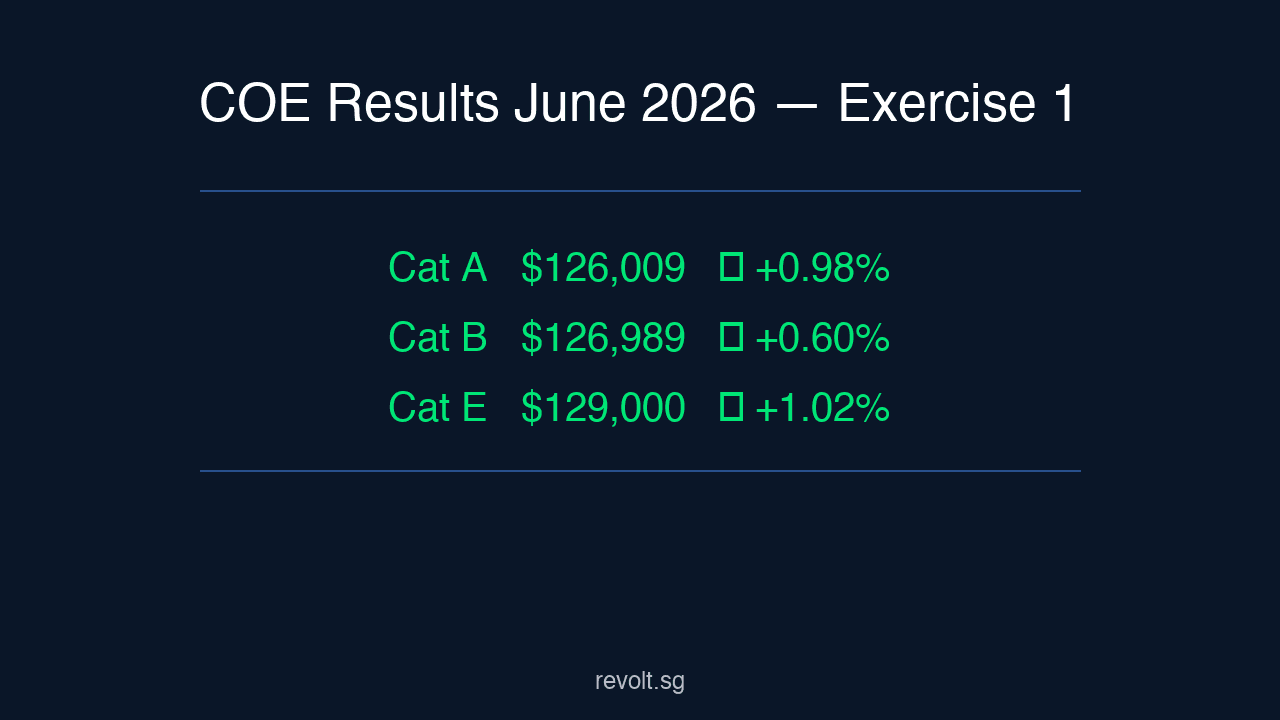
All three main COE categories moved higher in the first exercise of June 2026, which closed on 4 June 2026 — a Thursday, observed as Vesak Day in lieu. Category E (Open) recorded the largest absolute gain, climbing $1,300 (+1.02%) to $129,000. Category A reached $126,009 (+$1,219, +0.98%) and Category B settled at $126,989 (+$753, +0.60%), leaving a gap of just $980 between the two.
Category A — $126,009
Cat A, which covers non-electric petrol and diesel cars up to 1,600cc or 97 kW, as well as fully electric cars rated at 110 kW or below, closed at $126,009 — up $1,219 (0.98%) from May 2026 Exercise 1. The quota was 1,246 certificates; 2,076 bids were received, making it 1.67× oversubscribed. The Quota Premium now sits $7,652 above the Prevailing Quota Premium of $118,357, confirming a sustained upward trend. For EV buyers in this segment, home charging setup remains a key factor in overall running costs alongside the COE outlay.
Category B — $126,989
Cat B, covering larger-engined and higher-powered vehicles — including fully electric cars above 110 kW — closed at $126,989, up $753 (0.60%) from the previous exercise. The quota stood at 889, against 1,300 bids received, giving an oversubscription rate of 1.46×. The QP is $5,771 above the PQP of $121,218. The $980 spread between Cat A and Cat B is notably narrow; the effective cost difference between an EV that qualifies for Cat A and one that does not is smaller than at any point in the past year.
Category E (Open) — $129,000
Category E, the open category that accepts any vehicle type and carries no PQP, rose $1,300 (1.02%) to $129,000. It was the most contested of the three, with 497 bids for 261 quotas — 1.90× oversubscribed. Cat E is typically used as a market ceiling indicator; its continued rise signals sustained underlying demand across the board.
Three-Exercise Trend
COE premiums have risen across all three categories in each of the last three exercises:
| Exercise | Cat A | Cat B | Cat E (Open) |
|---|---|---|---|
| Apr 2026 — Ex 1 | $118,000 | $121,000 | $121,001 |
| Apr 2026 — Ex 2 | $123,010 | $121,001 | $125,002 |
| May 2026 — Ex 1 | $124,790 | $126,236 | $127,700 |
| Jun 2026 — Ex 1 | $126,009 | $126,989 | $129,000 |
Cat A has risen $8,009 since April 2026 Exercise 1. Cat B has gained $5,989 over the same period. Cat E is up $7,999.
EV Context
For buyers considering a fully electric car, the relevant COE category depends on the motor's rated output. Most mass-market EVs — including the BYD Atto 3, Dolphin, and comparable models — fall under Cat A at 110 kW or below. Performance-oriented EVs typically bid in Cat B. With both categories above $126,000, the COE component alone represents a substantial portion of the total purchase cost. Buyers weighing long-term ownership costs may want to factor in charging infrastructure costs and, for those comparing models across different battery technologies, battery chemistry differences that affect degradation and resale value over a 10-year COE tenure.
Stay Charged Up
Get the latest EV news, reviews, and analysis delivered to your inbox every week.