COE Reform Singapore: Industry Split on How to Fix a System the EV Age Broke
A government review of Singapore's COE categories has divided motor traders and academics, with no consensus on whether to merge Cat A and B or refine them.
Editorial Team

Singapore's certificate of entitlement system faces its most significant structural review in years, triggered by a February anomaly that exposed how the rise of affordable electric vehicles has upended the logic underpinning the country's car quota regime. Acting Transport Minister Jeffrey Siow announced on March 4 that the Land Transport Authority will review how cars are categorised under the COE system, with findings expected by end-2026. But as the government opens up for feedback, motor traders and academics are finding it difficult to agree on what a better system should look like.
When Cheap EVs Made Mass-Market Certificates More Expensive
The COE system splits private cars into two main categories. Category A is meant for smaller, less powerful cars — and by extension, mass-market buyers. Category B is for higher-end, more powerful models. The intent has always been that Cat A premiums stay below Cat B, preserving some affordability for budget-conscious buyers.
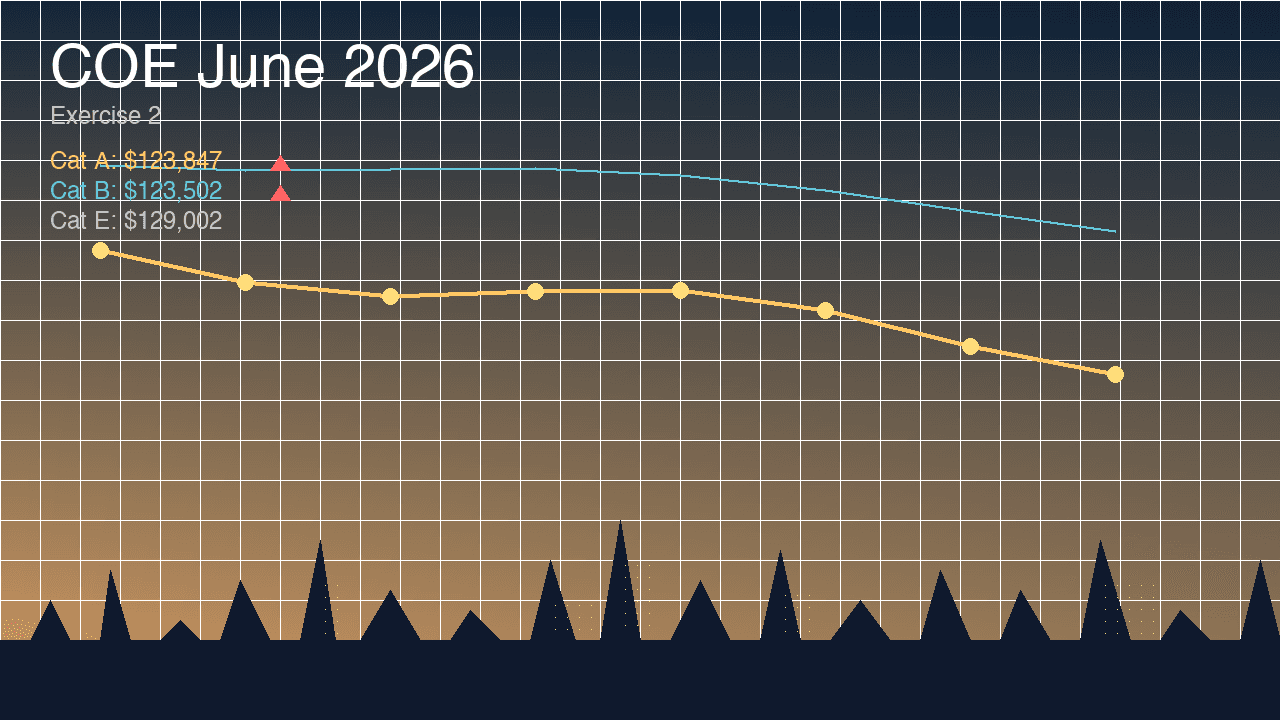
That logic broke down on February 20, when Cat A closed at $106,501 — some $1,500 above Cat B at $105,001. It was the first time since 2020 that the mass-market certificate commanded a higher price than the premium one.
The culprit, many in the industry say, is the flood of affordable Chinese electric vehicles into the market. Models from brands such as BYD are powerful enough to qualify as Cat B on paper, but their manufacturers have tuned the motors down to 110kW or below — the maximum threshold for Cat A EVs — to keep them in the cheaper pool. The result is a mass-market certificate pool competing against a much larger field than it was designed for.
MPs Edward Chia and Ang Wei Neng flagged the anomaly in Parliament, with Mr Chia going so far as to propose scrapping the two-category system entirely. Under his suggestion, all car buyers would draw from a single COE pool, with the final certificate price adjusted up or down based on the vehicle's open market value — effectively making higher-value cars pay more and budget models pay less.
A Divided Industry
The idea has its supporters among dealers. Mr Ng Choon Wee, commercial director of Komoco Motors, backs a full merger of Cat A, Cat B and even the Open Category (Cat E) into one unified pool. Mr Ernest Tan, deputy chief executive of Vincar, takes a similar position, noting that the tiered Additional Registration Fee already taxes higher-OMV cars more heavily — making a separate COE distinction arguably redundant.
But not everyone is convinced. James Ng, who heads BYD's operations in Singapore, warns that collapsing the categories could hurt the buyers the system was designed to protect. In a single bidding pool, budget-conscious buyers would face direct competition from those purchasing premium models, who are typically willing to pay more. Mr Ng prefers adding OMV as an additional criterion for Cat A qualification rather than eliminating the distinction altogether.
Associate Professor Victor Kwan from the Singapore University of Social Sciences also favours keeping the categories but recalibrating them using OMV rather than power output. He acknowledges the approach is imperfect: dealers can fine-tune declared OMVs to slip a model just under the threshold, and OMV fluctuates with exchange rates, meaning a car's category could theoretically shift from one batch to the next.
Nicholas Wong, chief executive of Honda agent Kah Motor, advocates for a more thorough overhaul — a system built on multiple criteria rather than one or two metrics, reviewed periodically to stay ahead of technology trends.
What EV Buyers Can Expect
For anyone planning to buy an electric vehicle in the coming year, the review introduces a degree of uncertainty that will be hard to ignore. If the LTA reshuffles the categories — raising the Cat A power threshold or introducing OMV-based sorting — some models currently sitting comfortably in Cat A could end up in Cat B, where premiums are typically higher.
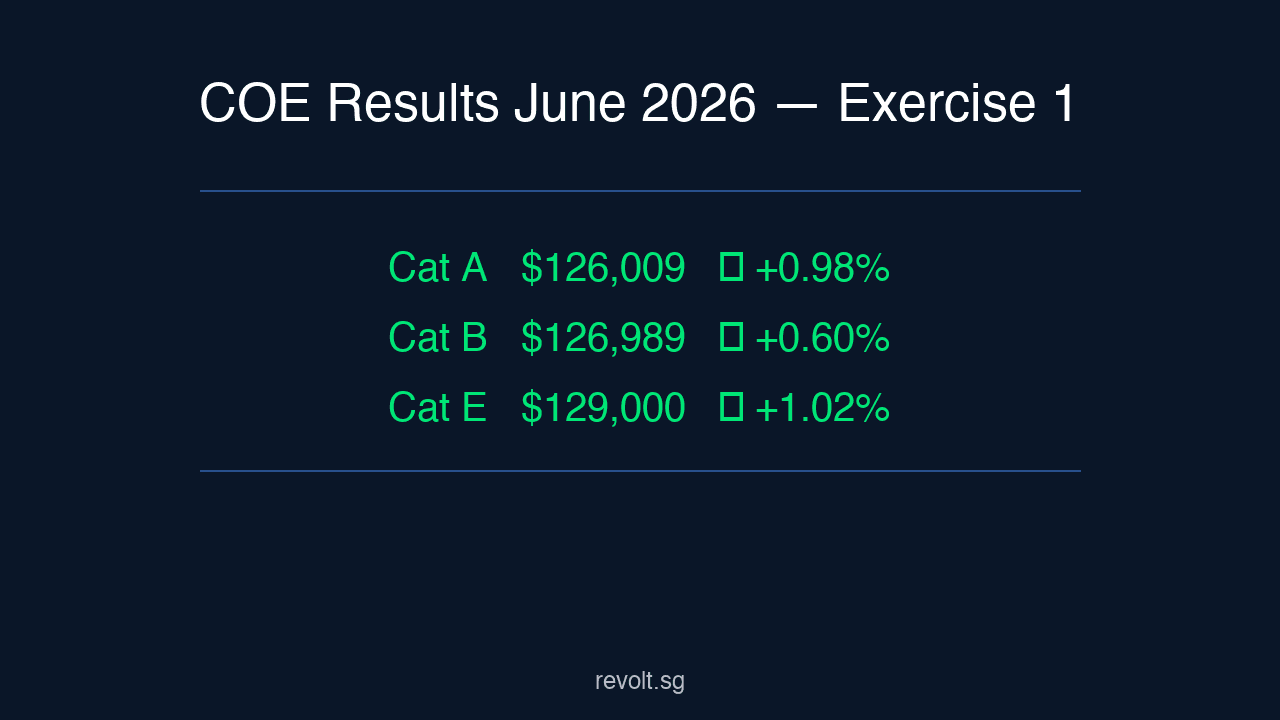
The March 4 tender, held on the same day as the minister's announcement, offered a taste of how quickly sentiment can shift. Cat B premiums jumped 8.6 per cent to $114,002, while Cat A rose more modestly to $108,220. The gap between the two categories has reopened since February, but the underlying pressure on Cat A from EV supply has not eased.
MP Foo Cexiang took a longer view, suggesting that Singapore's next-generation electronic road pricing system could eventually justify allowing more vehicles on the road — potentially reversing the zero vehicle population growth policy in place since February 2018. More COE supply would ease prices broadly. But that prospect remains speculative, and the LTA has made no such commitment.
BMW Group Asia summed up the industry's mood: any new system should be forward-looking and reflect the direction of automotive technology. There is broad agreement that the current framework is no longer fit for purpose. What comes next — and whether it makes Singapore's EV market more or less accessible — is the question the LTA now has until end-2026 to answer.
Stay Charged Up
Get the latest EV news, reviews, and analysis delivered to your inbox every week.